
Rapid Application Development Methodology: How and When to Use It

Want to know more? — Subscribe
Software development is a highly dynamic industry. For some projects and market requirements, it’s critical to implement changes in the product swiftly or…
Software development is a highly dynamic industry. For some projects and market requirements, it’s critical to implement changes in the product swiftly or develop it as fast as possible. In such cases, the rapid application development approach over-performs other software development methodologies.
Though the rapid application development framework could be considered one of the agile software development strategies, it differs. It focuses more on ongoing software projects and implementing user feedback or clients’ requirements right in the process rather than following a strict plan.
It becomes clear that such an approach can benefit many companies. So let’s move ahead and discover rapid software development in detail and why it might matter for your product.
Softermii uses different approaches to software engineering, with rapid app development among them. Thus, we’ll discuss the ins and outs of this methodology following our experience with real-life case studies.
Want a skimmable version?
Get a quick overview of our article with AI to access all the important information quickly.
Generate AI SummaryHide summary
Want a skimmable version?
Get a quick overview of our article with AI to access all the important information quickly.
Generate AI SummaryHide summaryRapid Application Development (RAD) methodology — its features, four process phases, and pros and cons.
Rapid Application Development Features
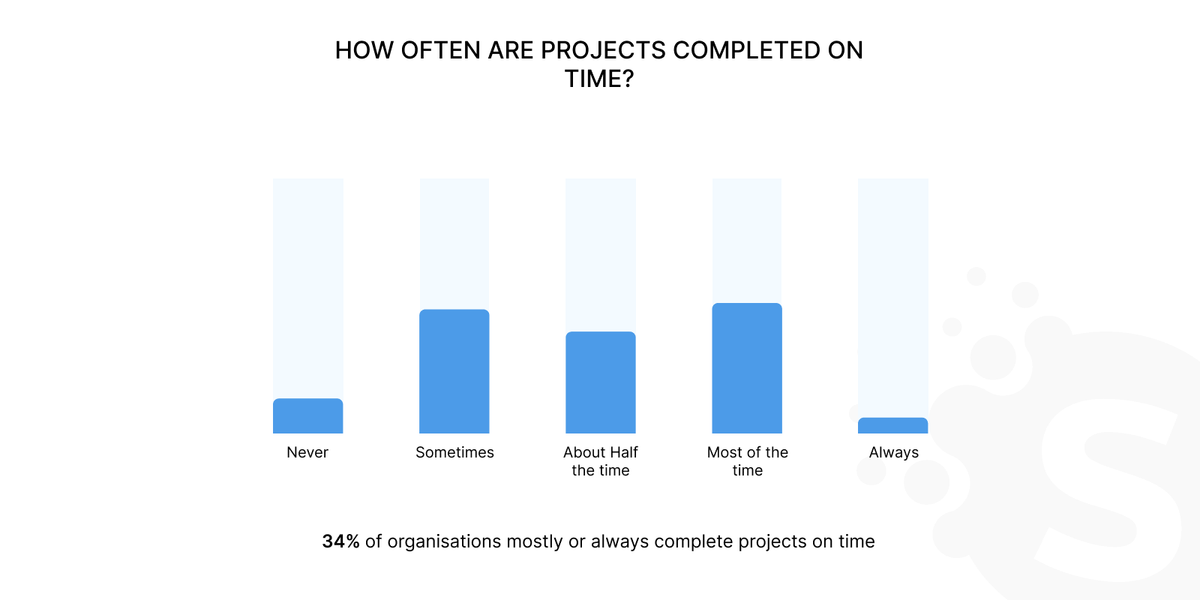
One of the most common problems for software development teams is spending a lot of time on planning and iteration stages and not delivering the product within the established terms. Therefore, according to the Wellingtone survey, only 34% of organizations complete the project on time.
The RAD methodology can help to solve this problem.
The main benefit of the RAD approach is treating software projects like clay rather than steel. It’s the idea that they should always be malleable. As you learn more about the RAD definition, you should remember that aspect of it.
RAD methodology first appeared in the 1980s and came from the Agile approach. It may not be new, but it’s still popular for teams looking for an agile strategy for application development that allows them to keep pace with increasing client, user, and business needs.
You also need to know that rapid application development prioritizes prototype releases and iterations. They emphasize software and user feedback over strict planning and requirement recording.
Rapid Application Development Process Phases
For decades, project management teams have stuck with the traditional software development strategy that includes strict planning, process, and documentation.
Read also: Project Management in Software & App Development
Any discussion of rapid application development pros and cons should mention that it focuses on minimizing the planning stage and maximizing prototype development. It reduces planning time and emphasizes prototype iterations.
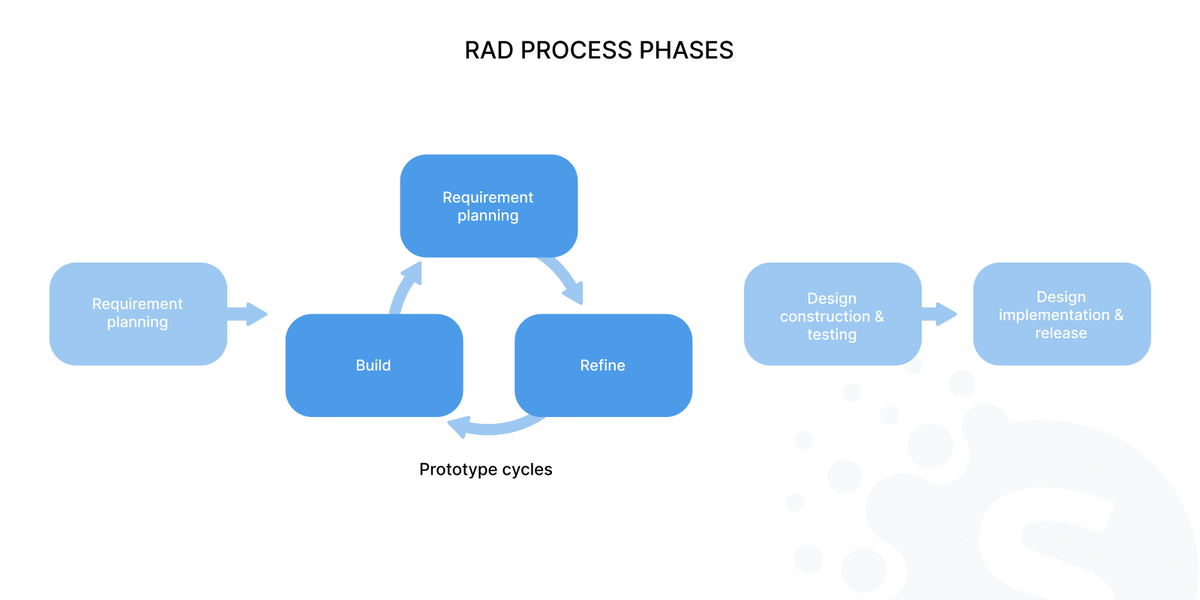
RAD allows project managers and stakeholders to arrange all project changes in real-time and implement them immediately. It enables greater efficiency, faster release and time-to-market, and effective communication.
Choose among 120 software specialists
Hire an offshore dedicated team or a few team members for your project. We guarantee 10% of deviation in deadlines and cost.
Hire a teamPhase One: Requirement Planning
According to the above study, schedules are baselined in around 48% of projects. Baselining, in other words, approval of project planning documentation should be of the planning stage, which allows tracking the software development progress against plans.
The rapid app development planning stage is like a project scoping meeting that results in creating a scoping document. During this stage, developers, stakeholders, and team members communicate to define the project’s goals. They also review current and potential issues to be addressed during the build.
Tip: This stage includes:
- Researching the current problem
- Defining project requirements and specifications
- Approval of those requirements by stakeholders
- Evaluating the goals and expectations for the project
Phase Two: User Design and Prototypes
Design development is the second of the rapid application development phases. It involves building the common stages of the design process. The primary goals of this phase are to develop customer journeys and wireframes, apply the main UX deliverables, and finalize the design version through various prototype iterations.
During this stage, clients work closely with developers. In such a way, they can discuss the project requirements met at every step of the design process. It’s similar to customizable software development, where the users test each product prototype at every stage to see if it meets their expectations.
All the kinks and bugs are worked out through iterative means. The development team designs a prototype, and the client and users test it. Then, all the issues are discovered, and comments are considered in the next design version. This method lets developers tweak the model until they devise a satisfactory design.
Tip: At the end of this stage, you have the final tested design version that you implement into the software.
Phase Three: Rapid Construction
This phase’s main task is to put the design prototypes into beta systems and then into a working model.
Developers discover most problems and make changes through the iterative design phase. Now, they can construct the final working model more quickly than they could by following a traditional project management approach.
Tip: This phase includes:
- Preparation for rapid construction
- Program and application development
- Coding
- Unit, integration, and system testing
This third phase is vital because the client still has the opportunity to give input. They can suggest changes or new ideas that will solve problems as they arise.
Phase Four: Cutover
It’s the implementation phase when the finished product is launched.
Tip: At this stage, you need to care about the following:
- Data conversion
- Testing
- Getting client feedback
- Finalizing your system
Rapid Application Development Model Pros & Cons
Well, now you know the main phases of rapid application development methodology. Let’s look at the advantages and disadvantages the RAD approach has for your project.
34%
According to the Wellingtone survey , only 34% of organizations complete the project on time.
RAD Model Pros
Here are the main benefits of the rapid app development model:
- High flexibility and adaptability. You can change the requirements at any time. The developers can make adjustments quickly during the development process.
- Optimized team efficiency. Thanks to RAD methodology, you can divide the project into more manageable tasks and measure the software efficiency more effectively.
- More focus on development. With a shorter planning phase, the team focuses more on iterative design construction and development.
- Reduced development time and faster delivery. The time between prototypes and iterations is shortened.
- Encouragement of code reuse. It means less manual coding, less room for errors, and shorter test times.
- Increased reusability of components.
- A focus on customer satisfaction. RAD uses client feedback for further iterations and allows for high-level collaboration and coordination between investors.
- Reduced risks. Stakeholders can discuss and address code vulnerabilities while keeping development processes going.
- Fewer surprises. Unlike the waterfall method, RAD includes integrations early in the software development process.
- Integration is easy since it is involved from the inception of the project.
RAD Model Cons
Certainly, as with other ones, the RAD model has some disadvantages that should be critical to know about before your choosing it:
- It requires skilled developers and designers.
- There is a high dependency on modeling skills.
- It’s more complex to manage when compared with other models.
- It’s only suitable for systems that are component-based and scalable.
- User requirements throughout the lifecycle of the product must be calculated.
- RAD is object-oriented and matches best for modularized systems.
- RAD isn’t designed to work well with smaller projects. It requires automated code-generated tools, making it suitable for projects with minimal development time.
- Features are often eliminated to fit time limits. Some functions are developed in the later versions to speed up the product’s first release.
- Scalability is challenging when using RAD as the prototype evolves into a finished application.
- Hard to track progress and software issues because of little to no documentation.
Rapid Application Development Tools
Since rapid development requires specific tools to work smoothly, you should discover some of those. Here are the most common:
- Alpha Anywhere. It’s a platform that allows the development of databases, web, and hybrid mobile applications.
- Yeeflow. It’s a RAD platform for no-code development with drag-and-drop features.
- EachScape. It’s a low-code RAD tool suitable for iOS, Android, hybrid, and web app development.
- QuickBase. It’s a no-code RAD platform that enables building apps for various industries.
- ViziApps. It’s a cloud-based app builder with drag-and-drop features and visual design tools.
If you have a dedicated team of 5 to 10 people that work closely with your clients and support flexibility in the development process, then RAD is perfect for you.
RAD vs. Other Software Development Models
Let’s look at some factors that distinguish RAD software development from other approaches.
Development Speed
The critical difference between RAD and other models is how rapid application development focuses on speed. Other models usually concentrate more on bringing a working product to the customer, regardless of how long that takes.
Team Members
Rapid application development benefits from having a single team without too many members. It allows for fast communication, frequent meetings, and the quick transfer of information. While for other development models, it differs. For example, the Agile team model prefers having larger teams divided into different specializations.
End-User
For rapid application development, keeping the end-user involved throughout the entire development process is critical. Other models are typically limited by users’ research only at the beginning and the users testing at the end of the development cycle.
Rapid Application Development and Agile
Agile is one of the most common software development methodologies, though it was developed after RAD appeared. There are the following differences between these two models:
- RAD is a predecessor of Agile, but Agile encompasses far more than a development model.
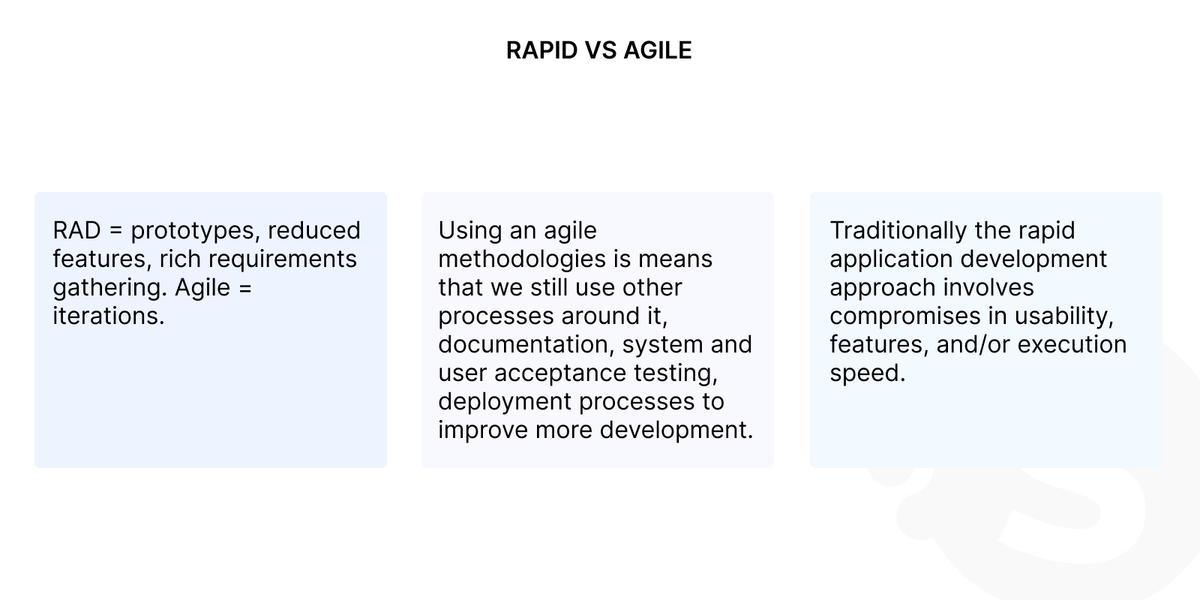
- The RAD model doesn’t set up a particular timeline for iterations. Instead, the focus on development speed is clearly emphasized.
- Unlike Agile, feedback from the end-users is critical to the RAD process.
- RAD principles are focused on functionality and user satisfaction. Agile emphasizes the technical side and sound design.
- RAD doesn’t limit itself to a team structure as Agile does.
RAD Model vs. Traditional SDLC
Let’s briefly outline the difference between the RAD approach and the traditional SDLC. We summarized the main points in the table below:
| Characteristic | RAD Model | SDLC Model |
|---|---|---|
| Characteristic | RAD Model | SDLC Model |
| Development stages | RAD has no clearly defined dev stages. | SDLC has clear and structured dev stages. |
| Stages review | RAD allows reviewing dev stages at any necessary time. | In SDLC, you cannot go back to the completed dev stages. |
| Development speed | The development speed is fast due to automated RAD tools and strategies. | The development speed is slower compared to RAD. |
| Project requirements | RAD doesn’t require a precise requirements outline before development, and they can change during the project. | The SDLC requires a clear definition of requirements before development begins. |
| Project changes | RAD allows effortless implementation of changes. | Implementing project changes in SDLC is challenging because of the strict step-by-step essence of this model. |
| User feedback | RAD heavily relies on user feedback. | SDLC uses minimum user feedback. |
| Team size | The RAD approach involves a small dev team. | The SDLC approach involves a large dev team. |
| Project type | RAD suits low-budget, short-term projects best. | SDLC suits long-term projects best. |
| Components | RAD involves component reuse, reducing development time. | SDCL doesn’t involve the reuse of components. |
When to Use Rapid Application Development Methodology
For sure, the RAD model does not apply to every project and team. But in some cases, it’s particularly beneficial. So for the last point, let’s discover in what matters the rapid application is helpful:
When You Can Reliably Test Your Prototypes
Do you have the means to test your design prototypes with users who can give feedback on the prototypes you make? If so, then rapid application development is a great model to follow.
When You Have the Budget
Compared to other development models, rapid application development is relatively inexpensive. There are always outlying instances, though.
When You Need a Project Done Rapidly
Rapid application development is your best bet if you have a tight deadline. If you’re under pressure to deliver something that works, opting for a RAD platform is always suitable.
Where Can Rapid App Development Model Not Be Used?
The RAD model for agile software development may suit numerous instances. But there are always some exceptions. Let’s look at the cases when RAD may not be the best choice.
No Dedicated Development Team
The RAD approach requires a reliable team of at least five experts who will constantly study user and client feedback and structure the development process accordingly. If you don’t have such a team, you should adopt RAD only after hiring one.
No Client Commitment
Again, as with a dedicated team, the RAD model may not be the best option if your client isn’t willing to share feedback and participate in the development process.
Specific Budget and Time Requirements
The RAD model isn’t suitable for projects with clearly established budgets and time frames. Although this approach makes it possible to develop software quickly and cost-effectively, it still doesn’t have defined limits, which can be problematic in some cases.
Examples of Rapid Application Development
Softermii’s team approaches software development with speed and flexibility in mind. That’s why we frequently use a rapid app development model in our processes.
Parta
Parta is one of the projects where we applied the RAD approach. It’s a mobile app that combines the best features of popular social networks like Tiktok, Instagram, Twitch, and Clubhouse. Thus, it allows streaming, broadcasting, audio and video conferencing, chatting, following users, and more.
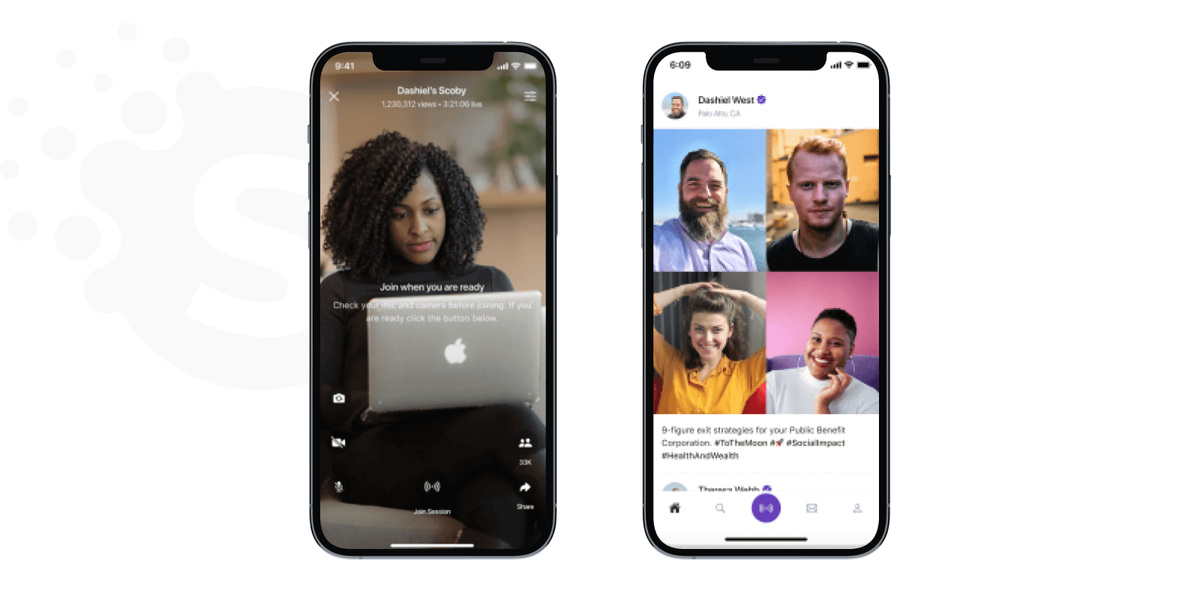
Our team started this project with requirement planning. First, we conducted a business analysis. We also evaluated various video broadcasting technologies and found our best fit: Mediasoup.
Leveraging relatively new technologies in our project, we had to make our product viral and competitive. We developed customer journeys by studying user requirements and paid significant attention to UX design. After that, we initiated the development process.
By using the RAD approach, we delivered the app’s MVP as fast as three months with a team of just five specialists. We also supported the application’s launch, which was successful.
My Health Explained
My Health Explained is another project in which we applied the rapid app development methodology. This way, we delivered a mobile and web healthcare platform for people with diabetes.
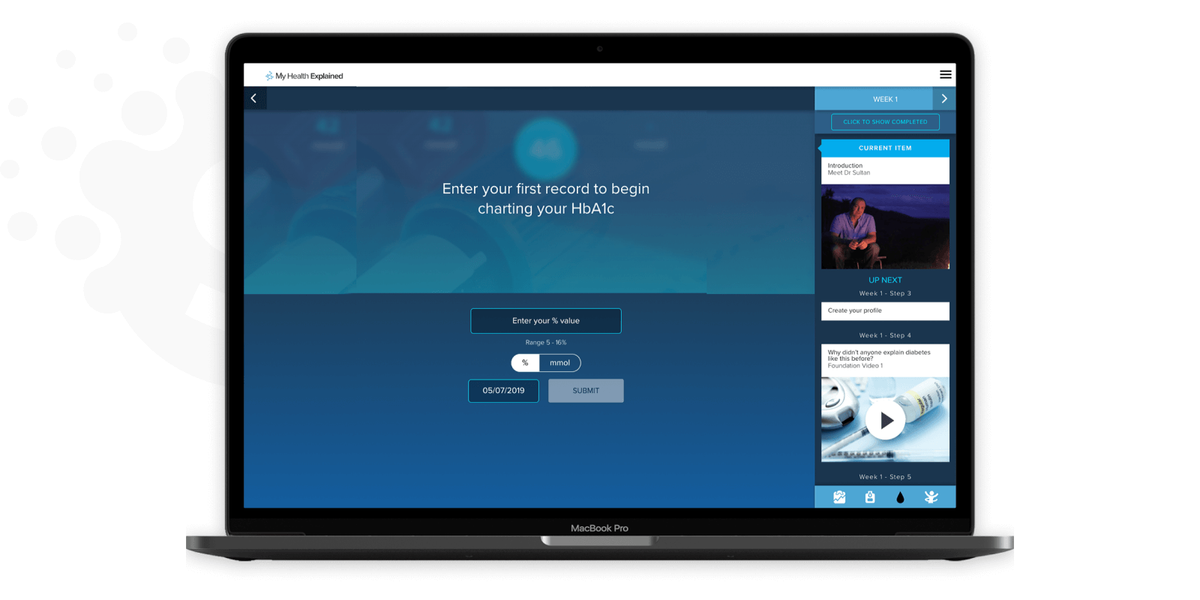
Our team had to build an app that would help patients control the course of the disease and reduce the negative impact of diabetes on their lifestyle. Our primary task was to create a tailored solution that would consider individual health issues and offer relevant recommendations accordingly. Plus, the app’s UX had to be intuitive and smooth.
Thus, during the requirements planning stage, our team studied the patient needs and designed diabetes programs for people with different types of diabetes accordingly. We have also implemented personalized recommendations following each patient’s health records.
Furthermore, our team paid specific attention to user flow and the overall UI/UX of the platform. We delivered a design customized to each patient’s needs.
Our team was able to develop My Health Explained in just three months. We have created a fast and easy-to-use platform with a high level of personalization that has helped many patients improve their health records.
Final Thoughts
Now you know about the RAD development stages, use cases, benefits, and limitations. Think about those matters when considering using this methodology for your project.
Yet, if you still hesitate about whether the RAD approach suits your software project, you can always get our free consultation on project management to set the best strategy for your case.
Remember that the rapid application development model will only succeed if it meets your project goals and runs correctly. Contact our dedicated team to help you streamline your dev process with this methodology.
If you need to implement changes in your product swiftly or develop it as fast as possible, drop us a line !
Frequently Asked Questions
Does Softermii provide a RAD development model?
Yes, we do. Our team has delivered several projects through this model.
What is the fundamental difference between the RAD and Scrum approaches?
RAD places less emphasis on planning and more on the adaptability of the development process. Scrum, in turn, emphasizes the control of the dev process.
What is the general strategy of rapid development?
This model focuses on speed. In RAD, you initiate the development process almost immediately, shaping the project requirements along the way.
What are the characteristics of rapid software development?
Some features include constant user feedback, increased dev speed, better adaptability and flexibility, less manual coding, and faster time-to-market.
How do I know RAD suits my team?
If you have a dedicated team of 5 to 10 people that work closely with your clients and support flexibility in the development process, then RAD is perfect for you.
How about to rate this article?
1017 ratings • Avg 4.9 / 5 · Thanks for rating!
Written by:

CEO & Co-Founder
Slava Vaniukov is the CEO and Co-Founder of Softermii, with more than 10 years on the front lines of software development. He has spent that decade helping founders and enterprises turn ambitious ideas into products that ship — and that perform. Apps built by his teams have been featured on multiple “Top 10 Best App…