
How Much Does AI Agent Development Cost in 2026? Complete Pricing Breakdown

Want to know more? — Subscribe
Every CTO asks the same question before greenlighting an AI agent project: how much will this actually cost?
And every time they Google "AI agent development cost," they get the same frustrating answer: "It depends." Followed by a range so wide it's meaningless — somewhere between $10,000 and $250,000. Thanks. Very helpful.
Most AI development cost articles online are useless. They all hedge behind disclaimers, throw out cartoon-wide ranges, and end with "contact us for a quote." This article is different. We're giving you actual numbers — what we charge, what the industry charges, and where the money really goes.
These figures come from building AI agent systems since 2014 across insurance, fintech, logistics, and healthcare at Softermii. We've shipped 100+ projects. We have a 4.9 on Clutch across 34 reviews. And we built a proprietary agentic AI system called APEX that has fundamentally changed what a proof of concept should cost. So the numbers here aren't theory — they're invoices.
Let's get into it.
Want a skimmable version?
Get a quick overview of our article with AI to access all the important information quickly.
Generate AI SummaryHide summary
Want a skimmable version?
Get a quick overview of our article with AI to access all the important information quickly.
Generate AI SummaryHide summaryAn honest 2026 pricing breakdown for AI agent development — real numbers, the seven factors that drive cost, and where budgets quietly blow up.
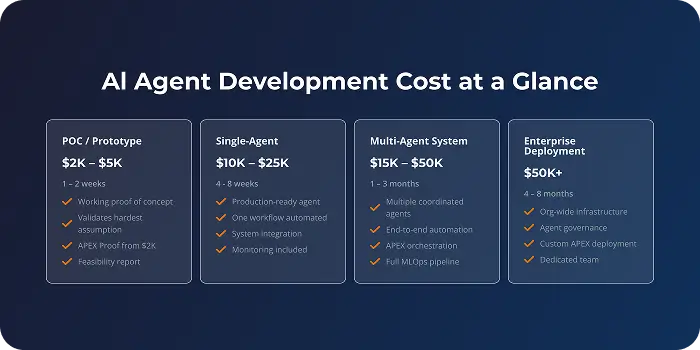
AI Agent Development Cost at a Glance
Here's the summary. Bookmark this table — it's the most honest pricing breakdown you'll find for AI agent development in 2026.
| Phase | Cost Range | Timeline | What You Get |
|---|---|---|---|
| POC / Proof of Concept | $2,000 - $20,000 | 5 days - 4 weeks | Working prototype proving feasibility |
| Production Build | $5,000 - $200,000+ | 2 weeks - 6 months | Deployable, tested system |
| Managed / Dedicated Team | $10,000 - $30,000/mo | 6 - 24 months | Ongoing development and scaling |
| Maintenance & Ops | $400 - $6,000/mo | Ongoing | Monitoring, updates, optimization |
Why are the ranges still wide? Because a simple FAQ assistant and a multi-agent insurance claims system are both "AI agents." One takes two weeks. The other takes six months. The complexity gap between them is enormous.
But unlike other articles, we won't stop at the summary table. Keep reading for exact pricing by use case, team composition, industry, and the hidden costs that blow budgets.
What Determines AI Agent Development Cost? (7 Factors)
1. Agent Complexity — Single vs. Multi-Agent
This is the single biggest cost driver. A standalone chatbot that answers FAQs from a knowledge base is a completely different animal from a multi-agent system where agents delegate tasks to each other, reason about failures, and interact with ten different APIs.
| Phase | Cost Range | What You Get |
|---|---|---|
| Simple (single agent) | FAQ bot, basic RAG assistant | $3,500 - $12,500 |
| Medium (task-specific agent) | Claims processor, sales qualifier | $20,000 - $40,000 |
| Complex (multi-agent workflow) | Orchestrated agent teams, autonomous pipelines | $60,000 - $200,000+ |
But unlike other articles, we won't stop at the summary table. Keep reading for exact pricing by use case, team composition, industry, and the hidden costs that blow budgets.
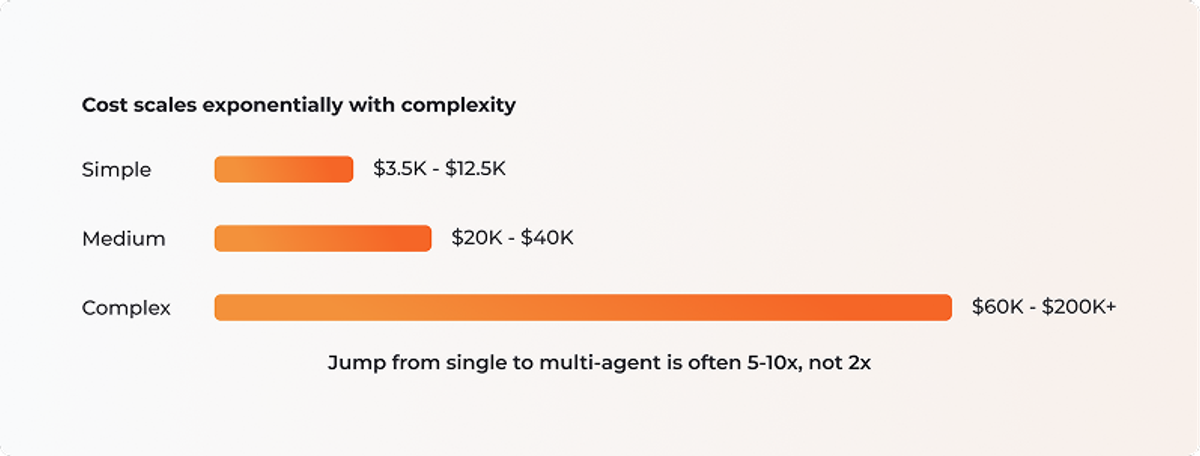
Here's what nobody tells you: the jump from single-agent to multi-agent isn't 2x the cost — it's often 5-10x. Orchestration logic, failure handling between agents, shared memory, evaluation frameworks — all of that adds up fast. Organizations using dedicated agent frameworks report 55% lower per-agent costs compared to platform-only approaches, but with 2.3x higher initial setup time (Arsum, 2026).
Our APEX system cuts this gap significantly. APEX includes pre-built orchestration, memory management, and agent communication patterns. So instead of building those from scratch (which is where most of the cost hides), you're configuring what already exists.
2. AI Model Selection and Licensing
The model you choose affects both build cost and ongoing operating cost. And the pricing landscape has changed dramatically — LLM API costs dropped approximately 80% year-over-year since 2024, with LLM inference costs declining roughly 10x annually (Epoch AI, 2025).
| Model | API Cost (per 1M tokens) | Best For |
|---|---|---|
| GPT-4o | $2.50 input / $10 output | Complex reasoning, multi-step tasks |
| GPT-4o mini | $0.15 input / $0.60 output | Simple classification, routing |
| Claude Sonnet | $3 input / $15 output | Long context, analysis, coding |
| Gemini Pro | $2 input / $12 output | Multimodal tasks, Google ecosystem |
| DeepSeek V3 | $0.14 input / $0.28 output | Cost-sensitive production, on-premise |
| Llama / Mistral (open-source) | Self-hosted: $500-$3,000/mo infra | Data-sensitive, on-premise needs |
Monthly API costs in production typically run $100 to $5,000+ depending on volume. A customer support agent handling 10,000 conversations per month might cost $500-$1,000 in API calls. A document processing agent chewing through thousands of pages daily could easily hit $2,500-$5,000.
Pro tip: Right-size your models.
We've built agents where 80% of the work runs on a cheaper model, and only the hard decisions get routed to a flagship LLM. That alone can cut API costs by 60-70%.
The open-source revolution helps too — the MMLU benchmark gap between open-source and proprietary models narrowed from 17.5 to just 0.3 percentage points in 2025 (Swfte AI). DeepSeek V3 inference runs up to 50x cheaper than comparable proprietary models.
3. Data Integration Requirements
Most AI agents don't work in isolation. They need to connect to your CRM, ERP, databases, document stores, and third-party APIs. Every integration adds cost.
| Integration Factor | Cost Impact |
|---|---|
| Number of source systems | $2,000 - $5,000 per integration |
| Data cleaning and preparation | 50-70% of total project time (Gartner, 2025) |
| RAG (Retrieval-Augmented Generation) setup | $3,500 - $10,000 |
| Vector database configuration | $2,000 - $6,000 |
| Real-time vs. batch data syncing | Real-time adds 30-50% cost |
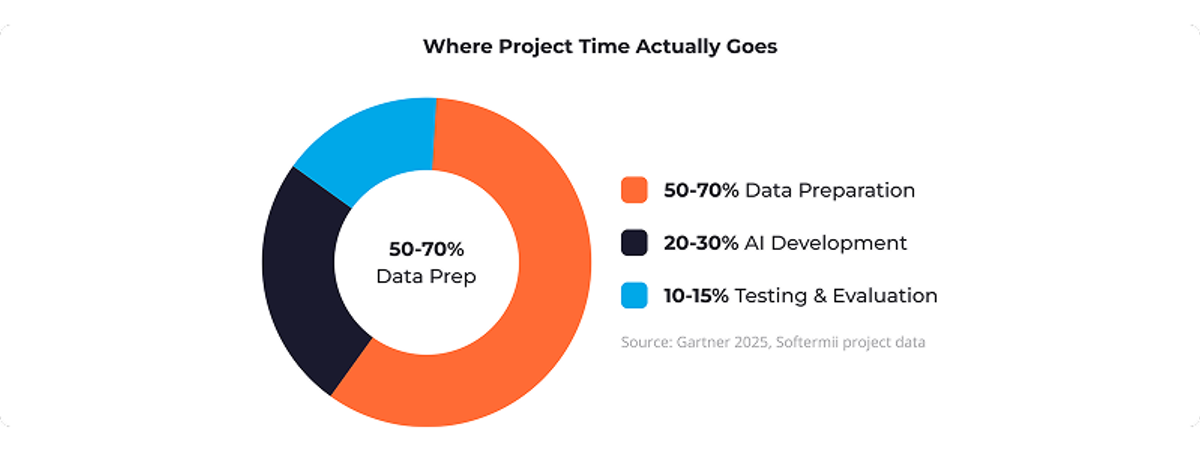
The data preparation piece is the one clients consistently underestimate. Your data is never as clean as you think it is. Gartner warned in February 2025 that organizations will abandon 60% of AI projects unsupported by AI-ready data through 2026. The winning programs earmark 50-70% of timeline and budget for data readiness. We've had projects where data prep took longer than the actual AI development.
If you need help getting your data AI-ready without rebuilding your systems, that's exactly what our AI integration services are built for — we handle data pipeline construction as a dedicated workstream.
4. Industry and Compliance Requirements
If you're in a regulated industry, budget for compliance from day one. Not after the build — from the start.
| Industry | Compliance Requirements | Cost Premium |
|---|---|---|
| Healthcare | HIPAA, PHI handling, audit trails | +25-40% ($45K-$60K for HIPAA-compliant AI apps) |
| Fintech | SOC 2, PCI DSS, KYC/AML | +15-30% (SOC 2: $20K-$40K initial) |
| Insurance | State regulations, claims handling rules | +20-35% |
| General / Tech | Minimal regulatory overhead | Baseline |
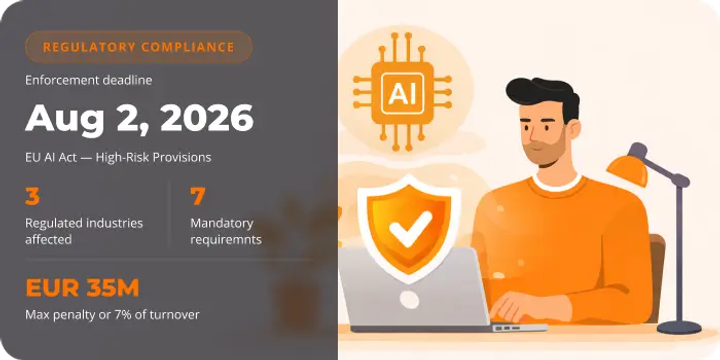
And then there's the EU AI Act. Prohibited practices are already banned (since February 2025). General-purpose AI rules are live (since August 2025). High-risk system rules kick in August 2026. If your AI agent makes decisions that affect people — hiring, lending, insurance underwriting — you're potentially dealing with high-risk classification.
CEPS estimates the compliance costs: SMEs face EUR 193,000-330,000 to set up a Quality Management System, with EUR 71,400 annually for maintenance. Large enterprises face $8-15M initial investment. Penalties reach EUR 35 million or 7% of global revenue. Budget an additional 15-40% for full EU AI Act compliance depending on risk tier.
5. Team Composition and Location
AI development requires specialized talent. And AI specialists earned 18.7% more in 2025 than in 2024 (Index.dev), so the talent premium is rising even as API costs fall.
| Role | US ($/hr) | Western Europe ($/hr) | Eastern Europe ($/hr) | Latin America ($/hr) |
|---|---|---|---|---|
| AI/ML Engineer | $150 - $300 | $100 - $200 | $35 - $65 | $45 - $80 |
| AI Architect | $180 - $350 | $120 - $250 | $40 - $80 | $55 - $110 |
| Full-Stack Developer | $100 - $200 | $70 - $150 | $30 - $55 | $40 - $65 |
| QA Engineer | $80 - $150 | $50 - $100 | $25 - $45 | $30 - $55 |
| DevOps / MLOps | $120 - $250 | $80 - $180 | $30 - $60 | $40 - $70 |
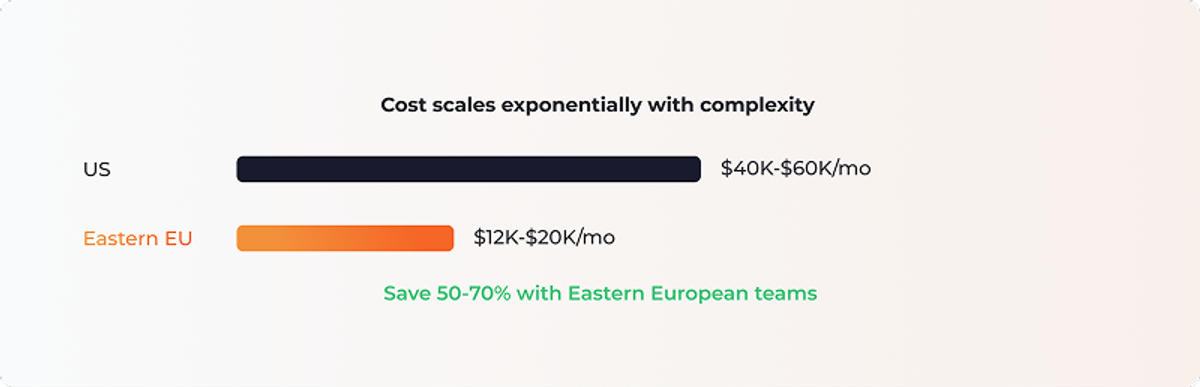
At Softermii, our team is based in Eastern Europe — certified by AWS, Microsoft, and Google, with PMP-certified project managers. You get senior-level talent at rates that are 50-70% lower than US equivalents. Not junior developers offshore. Senior engineers nearshore.
A typical AI agent project team includes: 1 AI architect, 1-2 AI/ML engineers, 1 full-stack developer, 0.5-1 QA engineer, and a project manager. That's $12,000-$20,000/month in Eastern Europe vs. $40,000-$60,000/month in the US for the same caliber of work.
6. Infrastructure and Hosting
Your AI agent needs somewhere to live. And 80% of enterprises underestimate AI infrastructure costs by more than 25% (Azilen, 2026).
| Infrastructure Component | Monthly Cost |
|---|---|
| Cloud compute (AWS/Azure/GCP) | $200 - $1,500 |
| Vector database (Pinecone, Weaviate, Qdrant) | $25 - $1,750 |
| LLM API costs | $100 - $5,000+ |
| Monitoring and observability (LangSmith, Helicone) | $50 - $250 |
| CI/CD and staging environments | $100 - $250 |
| Total monthly infrastructure | $475 - $8,750 |
The wide range maps directly to usage volume. A low-traffic internal tool might cost $475/month to run. A customer-facing agent handling thousands of daily interactions could reach $8,000-$9,000/month.
For vector databases specifically: self-hosting becomes cheaper than managed services above roughly 60-80 million queries per month or 100 million+ vectors. Below that threshold, managed services (Pinecone from $0.33/GB, Weaviate from $25/month, Qdrant with 1GB free) are more cost-effective.
7. Testing, Safety, and Evaluation
This is the line item most companies skip — and then regret.
AI agents aren't like traditional software. You can't just write unit tests and ship. You need:
- Hallucination testing — does the agent make things up?
- Red teaming — can users manipulate the agent into doing something bad?
- Bias audits — does it treat different user groups fairly?
- Evaluation frameworks — automated quality scoring across hundreds of test cases
- Edge case testing — what happens when the agent encounters something it's never seen?
Budget 10-15% of your total build cost for testing and evaluation. On a $100K project, that's $10K-$15K. Skip it and you'll spend more fixing production incidents. S&P Global found in 2025 that the proportion of organizations citing positive impact from AI investments actually fell year-over-year — largely because they lacked evaluation infrastructure to measure and iterate on real outcomes.
AI Agent Development Cost by Use Case
This is the table most people came here for. Real cost ranges by specific use case, based on projects we've built and industry benchmarks.
| Use Case | Complexity | Cost Range | Timeline |
|---|---|---|---|
| Customer support chatbot | Low - Medium | $3,500 - $15,000 | 2 - 6 weeks |
| Claims processing agent | Medium - High | $20,000 - $60,000 | 4 - 12 weeks |
| Sales qualification agent | Medium | $10,000 - $30,000 | 3 - 8 weeks |
| Document processing / extraction | Medium | $15,000 - $40,000 | 4 - 10 weeks |
| Multi-agent orchestrated workflow | High | $60,000 - $200,000+ | 8 - 24 weeks |
| Voice AI agent (phone/call center) | Medium - High | $25,000 - $60,000 | 4 - 12 weeks |
| Knowledge base / RAG agent | Medium | $10,000 - $30,000 | 3 - 8 weeks |
| AI-powered internal operations agent | Medium | $15,000 - $35,000 | 4 - 10 weeks |
The lower end of each range assumes you're working with a framework like APEX and have clean, accessible data. The upper end assumes custom builds with heavy integration, compliance requirements, and enterprise deployment.
For comparison, industry benchmarks from Cleveroad, Azilen, and ProductCrafters in 2026 show: reactive agents at $20K-$35K, intermediate agents at $40K-$70K, advanced agents at $80K-$120K, and enterprise multi-agent systems at $100K-$500K+. Our pricing is competitive because APEX eliminates the 60-70% of development effort that goes into infrastructure boilerplate.
The Real Cost of an AI Agent Proof of Concept
The POC stage is where most companies either waste money or don't spend enough to learn anything useful. Both are bad.
$5K - $20K
Industry average for an AI agent POC — 2-8 weeks
That range exists because most development teams build POCs from scratch — picking a framework, setting up infrastructure, writing boilerplate, figuring out prompt engineering patterns, building basic evaluation. Before anyone touches your actual business logic, two weeks are gone.
A working AI agent proof of concept can be built in 5 days with a fixed-price APEX Proof, compared to the industry average of $5,000-$20,000.
How? APEX is a pre-built agentic AI system. The orchestration, memory, tool-calling patterns, and evaluation frameworks already exist. We configure them for your use case instead of building from zero. That's why the cost difference is so dramatic — we're not cutting corners, we're eliminating boilerplate.
| Factor | Traditional POC | APEX Proof |
|---|---|---|
| Cost | $5,000 - $20,000 | From $2,000 |
| Timeline | 2 - 8 weeks | 5 days |
| What you get | Basic prototype, often throwaway | Working agent on production-grade framework |
| Reusability | Usually rebuilt for production | Same codebase scales to production |
| Risk | High — big upfront investment before validation | Low — validate before committing budget |
When does an APEX Proof make sense? When you need to validate a concept quickly, test feasibility with real data, or present something concrete to stakeholders before getting budget approval. That covers about 80% of situations.
When should you invest more? When your POC needs to integrate with multiple live systems, handle real compliance requirements, or demonstrate performance at scale. In those cases, $4K-$10K is reasonable.
AI Development Pricing Models Compared
There are four main ways to structure an AI development engagement. Each fits different situations.
Fixed-Price
How it works: Agreed scope, agreed price, agreed timeline.
Best for: Well-defined projects with clear requirements. A simple chatbot build. A specific automation.
Risk: Requirements change (they always do with AI). Scope creep gets ugly fast.
Typical range: $3,500 - $60,000 per project
Time & Materials
How it works: Pay for actual hours worked. Flexible scope.
Best for: Exploratory projects, R&D, projects where requirements will evolve.
Risk: Budget can grow if not managed. Need strong project management.
Typical range: $35 - $80/hr (Eastern Europe) or $100 - $300/hr (US)
Dedicated Team
How it works: A full team works exclusively on your project. Monthly retainer.
Best for: Long-term AI development, building multiple agents, ongoing product development.
Risk: Minimum commitment (usually 3-6 months). Overhead if workload fluctuates.
Typical range: $10,000 - $30,000/month
Product-Based: APEX Tiers
How it works: Structured tiers that take you from concept to enterprise deployment.
APEX Proof
Fixed price
5 days • Working POC
APEX Build
Fixed price
2 weeks • Production-ready
APEX Evolve
Fixed weekly rate
Ongoing • Optimization
APEX Scale
Fixed price
30 days • Enterprise
Best for: Companies that want to start small, validate quickly, and scale what works. The tiered approach means you never over-invest before you have evidence.
Want to see what an APEX Proof looks like for your use case?
Hidden Costs Most Companies Miss
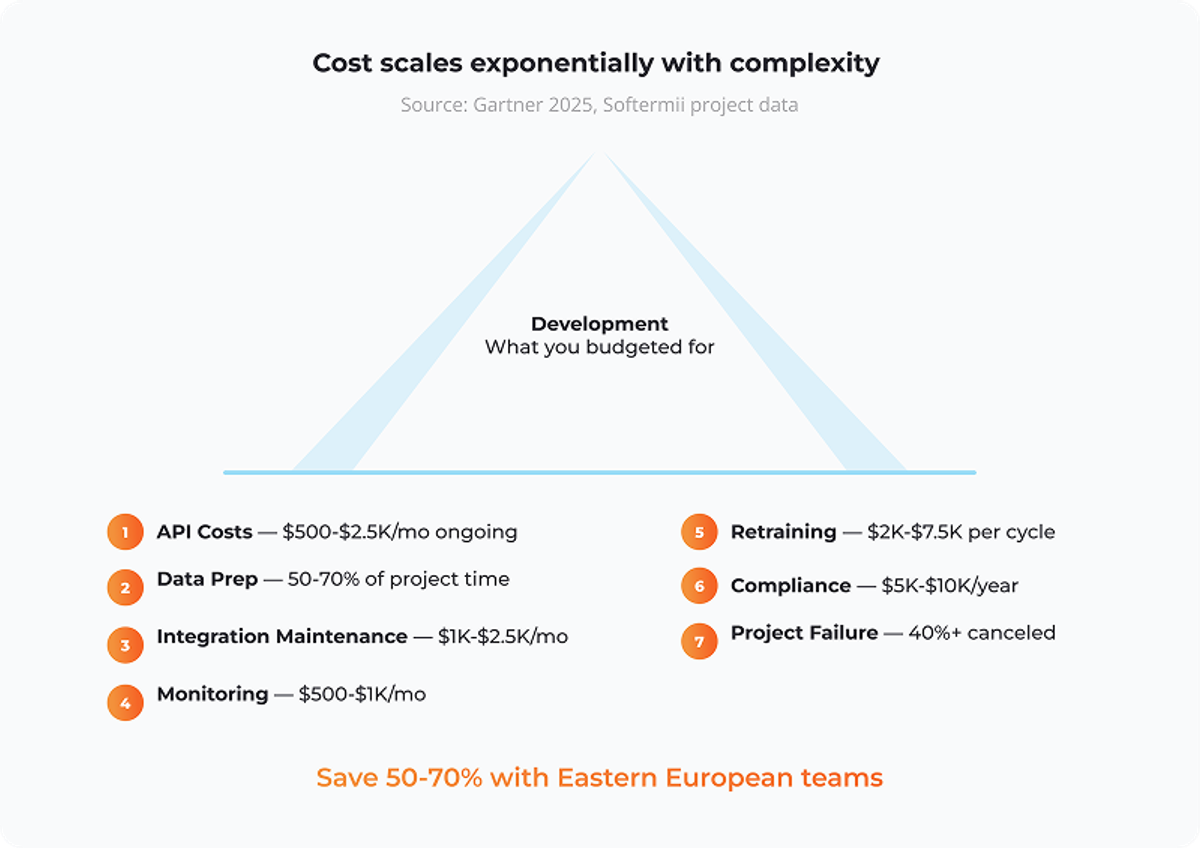
Budget blowouts on AI projects rarely come from the development itself. They come from the things nobody mentioned during the sales call. CIO.com reported in 2025 that 66.5% of organizations experience AI budget overruns, with first-year overruns typically running 30-40% over initial budget. Here are the seven hidden costs that cause it.
1. Ongoing Model API Costs
Your AI agent doesn't stop costing money when development ends. Every conversation, every document processed, every decision made costs API tokens. For a moderately active agent, expect $500-$2,500/month in API costs alone. The good news: API prices dropped roughly 80% year-over-year. The bad news: usage tends to scale faster than expected.
2. Data Preparation (50-70% of Project Time)
We see this every time. The client says "our data is ready." It isn't. Gartner's 2025 data shows winning AI programs earmark 50-70% of timeline and budget for data readiness. On a $100K project, that's $50K-$70K you didn't plan for if you didn't account for data prep. AI implementation costs increased 89% between 2023 and 2025 (Glean), and data work is a major reason.
3. Integration Maintenance
APIs change. Systems update. Data formats shift. Every integration your agent relies on needs ongoing maintenance. Budget $1,000-$2,500/month for integration upkeep on a moderately complex system.
4. Monitoring and Observability
You need to know when your agent starts hallucinating, slowing down, or giving bad answers. Monitoring tools, dashboards, alerting — this is $500-$1,000/month for tooling plus engineering time to respond.
5. Retraining and Fine-Tuning
Models degrade over time as the world changes and your business evolves. Plan for quarterly or semi-annual fine-tuning cycles: $2,000-$7,500 each time.
6. Compliance Updates
Regulations change. The EU AI Act is still being implemented — high-risk system rules hit August 2026. HIPAA interpretations evolve. If you're in a regulated industry, budget for compliance reviews and updates — typically $5,000-$10,000 annually. AI governance spending is projected to reach $492 million in 2026 and surpass $1 billion by 2030.
7. The Cost of Project Failure
Here's the hidden cost nobody talks about: Gartner predicts over 40% of agentic AI projects will be canceled by 2027. S&P Global found the average organization scrapped 46% of AI proof-of-concepts before production in 2025. If your $200K project fails, you haven't lost $200K — you've lost $200K plus 6 months of opportunity cost plus the political capital it took to get the project approved. The cheapest way to avoid this? Validate with a low-cost POC before committing serious budget.
Our recommendation: budget 20-30% on top of your build cost for Year 1 operations.
So if your build costs $100K, plan for $120K-$130K total in the first year.
How to Reduce AI Agent Development Costs Without Cutting Corners
1. Start With a Low-Cost POC
Don't spend $200K building something that might not work. Start with a fixed-price APEX Proof, validate the concept in 5 days, then decide whether to invest. This alone saves companies an average of $20K-$50K on failed approaches.
2. Use Pre-Built Frameworks
Building an AI agent from scratch in 2026 is like building a web app without a framework in 2010. Unnecessary. Tools like APEX, LangChain, CrewAI, and AutoGen give you a massive head start. The difference: APEX is a production system, not just a framework — it includes deployment, monitoring, and scaling patterns out of the box.
3. Right-Size the Model
Not every task needs a frontier LLM. Run classification on a smaller model. Use the big models only for complex reasoning. Open-source models closed the gap dramatically — the MMLU benchmark difference between open-source and proprietary narrowed from 17.5 to 0.3 percentage points in 2025. We've seen model right-sizing reduce API costs by 60-70% with zero quality loss on simpler tasks.
4. Nearshore Your Team
Eastern European AI engineers (Ukraine, Poland, Romania) deliver the same quality as US-based teams at 50-70% lower cost. With AWS, Microsoft, and Google certifications. We're biased here, obviously — but the math is the math.
5. Build Incrementally
Ship a single-agent system first. Prove value. Then add agents, integrations, and complexity. Every increment should deliver measurable business value. This isn't just cheaper — it's how you avoid becoming part of the 40% that Gartner says will be canceled.
6. Invest in Evaluation Early
Spending $10K on a proper evaluation framework saves you $50K on production debugging. Test early. Test often. Automate your testing. This is the one area where spending more upfront saves you dramatically more later.
AI Agent Development Cost by Industry
Different industries have different baselines because of varying compliance requirements, data complexity, and integration needs. The ROI data is increasingly concrete.
| Industry | Cost Range | Timeline | Use Case |
|---|---|---|---|
| Insurance | $20,000 - $40,000 | +20-35% | 210% ROI in 12 months (Anadolu Sigorta); 78% cost reduction in claims adjudication |
| Fintech | $25,000 - $50,000 | +15-30% | Up to 70% KYC cost reduction (HBR); 80% faster onboarding (ABN AMRO) |
| Healthcare | $30,000 - $60,000 | +25-40% | $20M-$100M+ annual savings (Becker's); 42% less documentation time |
| Logistics | $15,000 - $32,000 | Minimal | 3x ROI in 12 months; 12% transport spend reduction (DHL) |
| E-commerce / SaaS | $10,000 - $30,000 | Minimal | 40-60% support ticket reduction; 25-35% conversion lift |
Insurance and healthcare carry the highest compliance overhead. Logistics tends to be the most cost-effective because the regulatory burden is lighter and the use cases (dispatch, routing, exception handling) map cleanly to agent architectures.
How to Budget for AI Agent Development in 2026
If you're putting together a budget proposal, here's a framework based on company size and typical scope.
| Budget Line | SMB | Mid-Market | Enterprise |
|---|---|---|---|
| POC / Proof of Concept | $2,000 - $4,000 | $4,000 - $10,000 | $12,000 - $20,000 |
| Production Build | $10,000 - $40,000 | $40,000 - $80,000 | $120,000 - $200,000+ |
| Year 1 Operations | $4,000 - $12,000 | $12,000 - $20,000 | $40,000 - $60,000 |
| Total Year 1 | $15,500 - $56,000 | $56,000 - $110,000 | $172,000 - $280,000+ |
Step-by-step budgeting approach:
- Define the use case clearly — "we want AI" is not a use case. "We want an agent that processes insurance claims from email submissions and routes them to adjusters with a risk score" is.
- Run a POC first — validate feasibility and get realistic cost projections based on your actual data and systems. APEX Proof does this in 5 days at a fixed price.
- Budget for the full stack — development + infrastructure + API costs + monitoring + compliance. Don't just budget for the build.
- Plan for Year 1 ops — add 20-30% on top of build cost for first-year operations.
- Build incrementally — don't try to do everything at once. Ship the first agent, measure ROI, then expand.
The agentic AI market is approximately $7-8 billion in 2025 and projected to reach $47-65 billion by 2030 (MarketsandMarkets, Grand View Research). Gartner predicts 33% of enterprise software will include agentic AI by 2028, with 15% of day-to-day work decisions made autonomously by agentic AI. The question isn't whether to invest — it's how to invest smart so you don't become part of the 40% that get canceled.
Frequently Asked Questions
How much does a simple AI agent cost?
A simple AI agent like a customer support chatbot or FAQ assistant typically costs $3,500 to $12,500 to build, with a timeline of 2-6 weeks. This includes basic RAG setup, a single LLM integration, and standard deployment. Using a framework like APEX can bring the starting cost down to $5,000 for production-ready builds, compared to the industry average of $20,000-$35,000 for similar reactive agents.
How much does a multi-agent AI system cost?
Multi-agent AI systems with orchestration, shared memory, and cross-agent communication typically cost $60,000 to $200,000 or more, with timelines of 8-24 weeks. The cost scales with the number of agents, complexity of their interactions, and the number of external system integrations required. Industry benchmarks (Azilen, Cleveroad, 2026) show enterprise multi-agent systems at $100K-$500K+.
What is the hourly rate for AI developers?
AI developer hourly rates in 2026 range from $35-$65/hr in Eastern Europe, $45-$80/hr in Latin America, $100-$200/hr in Western Europe, and $150-$300/hr in the US. AI specialists earned 18.7% more in 2025 than 2024 (Index.dev), commanding a 30-50% premium over general software developers. Senior AI architects reach $80/hr in Eastern Europe and $350/hr in the US.
How long does it take to build an AI agent?
A simple AI agent takes 2-6 weeks. A medium-complexity agent (claims processing, document extraction) takes 4-12 weeks. Complex multi-agent systems take 8-24 weeks. An APEX Proof of Concept can be delivered in 5 days from $2K, with production builds starting at 2 weeks.
What are the ongoing costs of running an AI agent?
Ongoing monthly costs for running an AI agent typically range from $400 to $7,500 per month. This includes LLM API costs ($100-$5,000), cloud infrastructure ($200-$1,500), vector databases ($25-$1,750), and monitoring tools ($50-$250). Budget 20-30% of your build cost annually for operations and maintenance.
Is it cheaper to build or buy an AI agent?
Building a custom AI agent costs $5,000-$200,000+ but gives you full control, customization, and IP ownership. Off-the-shelf solutions cost $50-$500/month per user but limit customization and create vendor lock-in. MIT's 2025 data is instructive: purchasing from specialized vendors succeeds approximately 67% of the time, while internal builds succeed only about 22%. For simple use cases, buying is cheaper. For anything involving proprietary data, complex workflows, or competitive advantage, working with a specialized development partner wins.
How much does an AI proof of concept cost?
The industry average for an AI agent POC is $5,000-$20,000 over 2-8 weeks. Using Softermii's APEX framework, a working proof of concept costs from $2,000 and is delivered in 5 days. The cost difference comes from using a pre-built production-grade system versus building from scratch — APEX eliminates 60-70% of the boilerplate development effort.
What is the cheapest way to start with AI agents?
The cheapest way to start with AI agents is a framework-based proof of concept. Softermii's APEX Proof starts at $2,000 for a working agent prototype in 5 days. This lets you validate feasibility with your real data before committing to a full production build, which is the single most effective way to reduce risk and avoid wasted spend.
Making the Right Investment Decision
The best pricing decision isn't finding the cheapest option. It's the one that lets you validate before you commit.
We've watched companies spend $200K on AI projects that should have been killed after a $5K POC showed the concept didn't work with their data. We've also seen fixed-price APEX Proofs turn into $500K enterprise deployments — because the proof gave stakeholders the confidence to invest.
The AI agent market isn't slowing down. The companies that get this right in 2026 will have a real operational advantage. The ones that either overspend on failed projects or wait too long will be playing catch-up.
If you want to test the waters with minimal risk, APEX Proof is the fastest way to get from "we're thinking about AI agents" to "here's a working one built on our data." Five days, one fixed price. And if it doesn't work, you've lost five days instead of six figures and six months.
Ready to see what an AI agent looks like for your specific use case?
Get a working proof of concept in 5 days — or a free proposal within 5 business days.
How about to rate this article?
2 ratings • Avg 5 / 5 · Thanks for rating!
Written by:

Co-Founder
Andrii Horiachko is a Co-Founder of Softermii with over 12 years of experience in software development, eight of them spent building and managing Softermii itself. He is responsible for technology-innovation in clients’ projects, making sure every product runs on a modern, carefully chosen tech stack that can sustai…