
"AI-First" Is Not a Tool Decision. It's an Accountability Decision.

Want to know more? — Subscribe
AI-First delivery isn't about using more AI — it's about who is accountable when AI-written code ships. See the five proofs it must show before you buy in.
Every software team you might hire now says the same three letters: AI. Copilots, code generation, automated testing, internal assistants. And the productivity is real — code appears faster than it used to.
So here's the uncomfortable question an idea leader should ask before signing anything: if AI writes the code, who is accountable when it ships something that shouldn't have?
If the honest answer is fuzzy, you haven't bought AI-First delivery. You've bought AI-assisted delivery — and quietly kept the risk on your side of the table.
AI-First delivery, defined
A way of building software where AI agents handle the high-volume production and verification, but a named human owns every outcome, oversight scales with risk, and maintainability is contracted at handover. It's the opposite of AI-assisted delivery — the same process with copilots bolted on, where the risk quietly stays with the buyer.
Using more AI doesn't make delivery safer
There's a widespread assumption that "AI-First" means "uses a lot of AI." It doesn't. A team can add every copilot on the market and still deliver exactly the way it did before — same process, same review habits, same unclear ownership — just faster.
That matters because AI changed the nature of the work, not only its speed. AI-generated output is probabilistic: the same prompt can produce different results, and "looks finished" and "is finished" have drifted apart. That doesn't reduce the need for quality control. It increases it.
Two independent findings make this concrete:
| Signal | What the research found | What it means when you're buying, not coding |
|---|---|---|
| GitClear 2026 (623M changed lines) | Duplicated code blocks up 81% since 2023; refactoring — the cleanup that keeps a codebase healthy — fell to 3.8% of changes (from 21% in 2022) | More copy-paste, less cleanup: a codebase that's cheap to launch and expensive to change later |
| Google DORA 2025 | 80%+ of developers feel more productive with AI, yet ~30% still distrust AI-generated code; higher adoption tracks with both faster delivery and more instability | The speed is real — and so is the instability, unless someone is accountable for governing it |
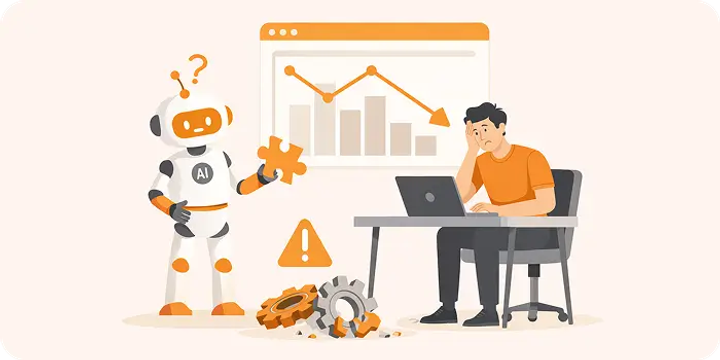
Translated for someone buying a product rather than writing it: AI can absolutely get you to launch faster. It can just as easily get you to a codebase that's expensive and slow to change three months later — right when you need to iterate. It's a big part of why most AI agent projects fail.
The failure pattern: "everyone can override AI, no one owns the decision"
When AI output flows into delivery without anyone answering who owns this, who validated it, who's accountable if it's wrong, a predictable failure pattern shows up: everyone can use the AI, plenty of people can edit or override it, but no one clearly owns the final call.
Risk then accumulates invisibly — across prompts, generated code, dependencies, release paths — until it surfaces as rework, a slipped launch, or a defect in production. Nobody decided to take that risk. It just wasn't anyone's job to prevent it.
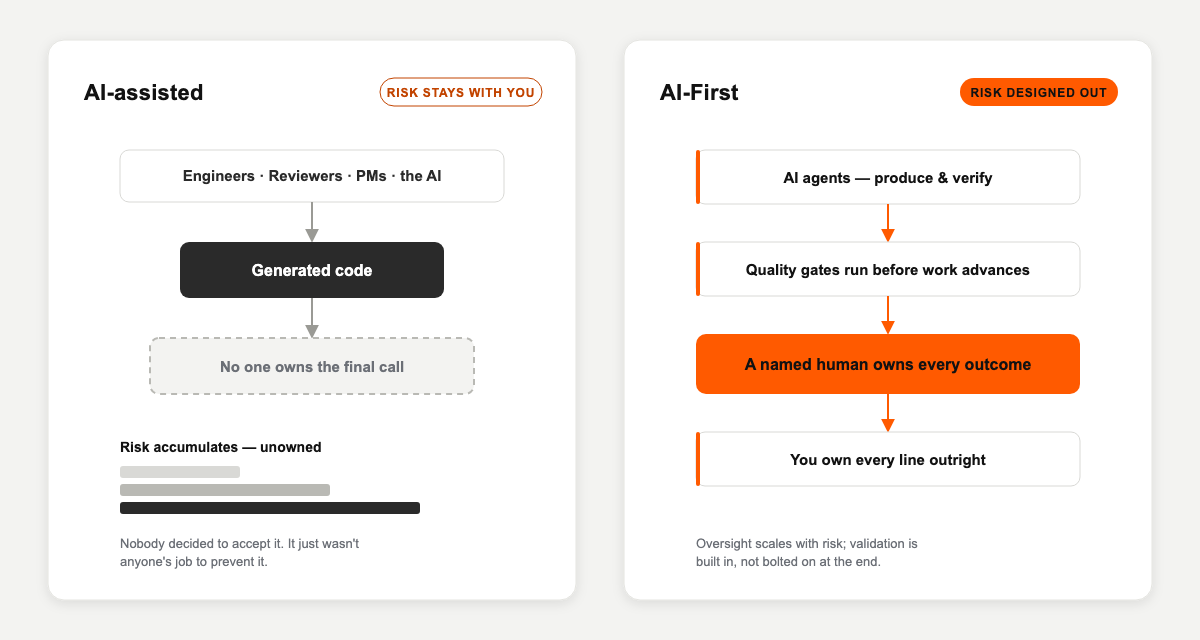
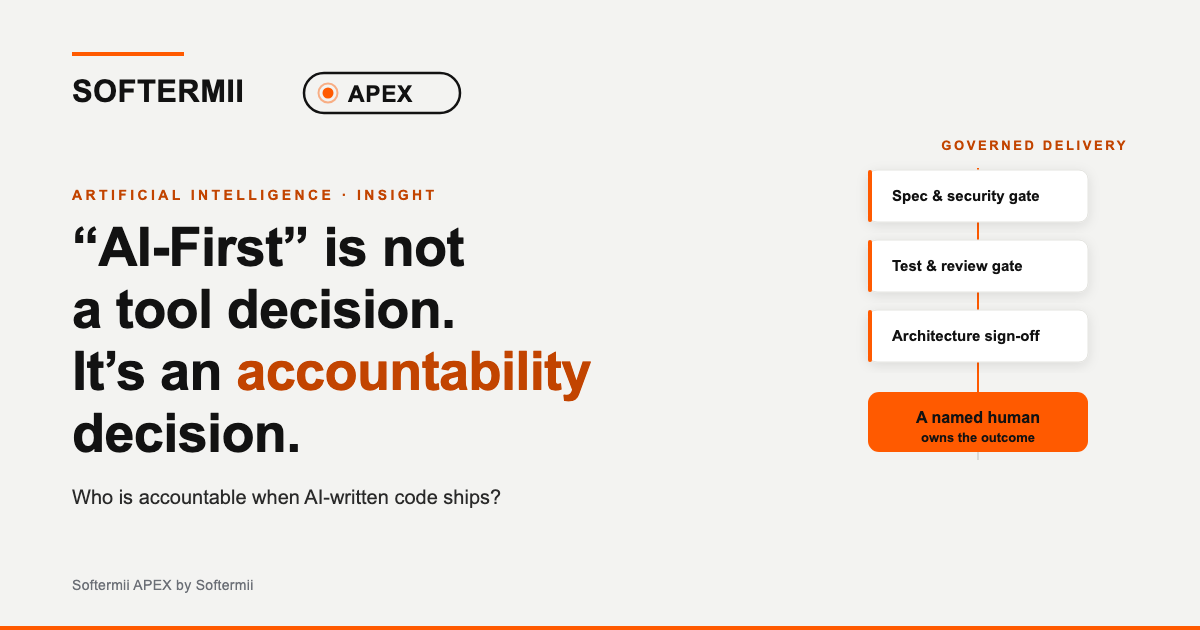
That's why AI-First is not a tooling decision. It's a decision about accountability and control: designing delivery so AI is a governed contributor and a named human owns every outcome.
Put the two models side by side and the difference isn't how much AI is used — it's where the risk ends up:
| Dimension | AI-assisted (risk stays with you) | AI-First (risk designed out) |
|---|---|---|
| What "AI" means | Copilots added to the same old process | AI is a governed contributor by design |
| Ownership of the outcome | Diffuse — many can override, no one owns | A named human owns every outcome |
| Oversight | Uniform or ad hoc | Scales with risk — a payment flow ≠ an internal utility |
| Validation | Bolted on at the end | Built into delivery, runs before work advances |
| Maintainability | Hoped for | Contracted and verified at handover |
| The code | Tied to whatever tool produced it | You own every line outright |
What does "AI-First done right" actually require?
Whether you're judging your own team or a vendor, the bar is the same. Real AI-First delivery can show you all five of these — so turn each one into a question and make them prove it:
| # | What AI-First delivery must show | Ask the team | What good proof looks like |
|---|---|---|---|
| 1 | A named human is accountable for what ships | "Who signs off — a person, or 'the AI'?" | A named owner per release, not a tool |
| 2 | Oversight scales with risk | "How is a payment flow reviewed vs an internal utility?" | Risk-tiered review you can see documented |
| 3 | Validation is built into delivery | "When exactly do spec checks, security/dependency scans and tests run?" | Gates that run before work advances, not at the end |
| 4 | Maintainability is contracted | "Can a new engineer build, test and deploy from the docs alone?" | A written standard, verified at handover — the test the market most often skips |
| 5 | You own every line outright | "Any licence-back, lock-in, or training on our data?" | Full assignment, no lock-in to the tool that produced it |
If a team can't show you how it meets all five, it has sold you speed and kept the risk.
You don't have to build this yourself
Here's the good news for anyone who just read that list and thought "I don't have the time or mandate to stand up a governance function." You don't have to.
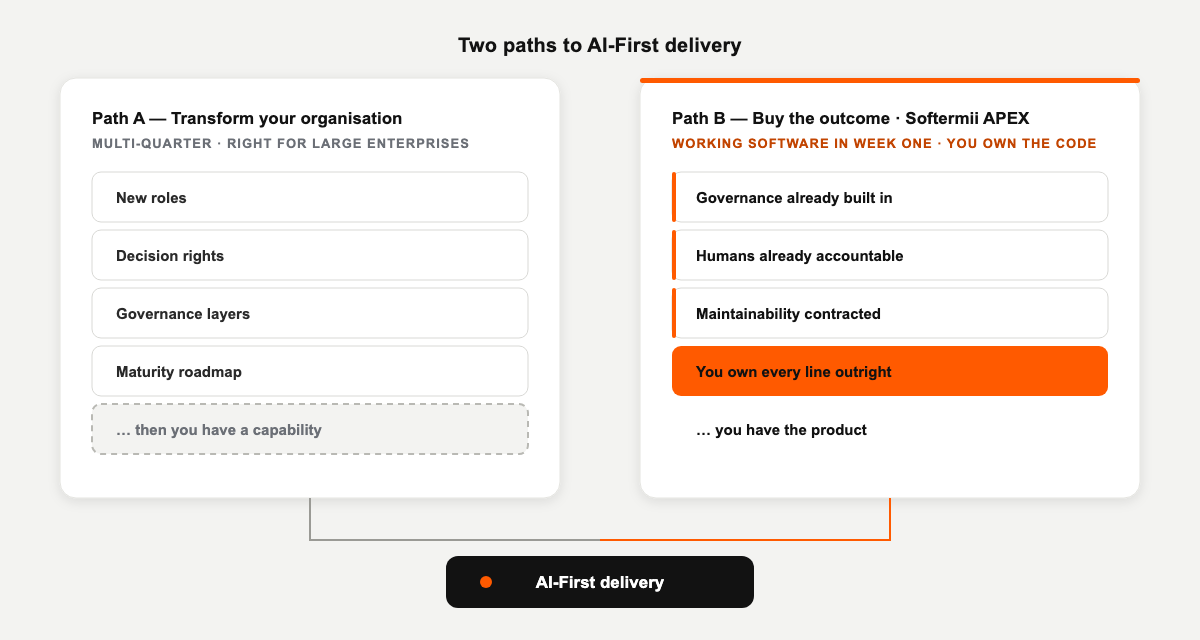
There are two ways to get AI-First delivery. One is to transform your organisation into an AI-First operating model — new roles, decision rights, governance layers, a maturity roadmap. That's a real, valuable programme, and it's the right project for a large enterprise redesigning how thousands of its people work. It is the wrong project for someone who needs one product built well, this quarter.
The other is to buy the outcome from a partner that already operates this way — where the governance is already built, the humans are already accountable, and the maintainability is already contracted.
That's what the Softermii APEX engine is: a proprietary agentic AI engineering engine where specialised AI agents produce and verify the volume — and safely integrate with the systems you already run — while a lean core of accountable Softermii experts owns the architecture, reviews everything that carries real risk, and stays responsible for what ships. You get one fixed price agreed before work starts, working software in week one, contracted maintainability verified at handover, and outright ownership of every line — without running a transformation programme to get there.
The takeaway
"Uses AI" is table stakes. Ask the sharper question instead — who is accountable, and can they prove the mechanism? That's the line between AI that helps your software get built and AI that just helps it break faster.

Want to see governed AI delivery on your own project?
Get your free itemised estimate — a named, Feature-level breakdown at a fixed price, within 24 hours. You see the budget. We absorb the unknowns.
Get your free itemised estimateFrequently asked questions
What is the difference between AI-assisted and AI-First delivery?
AI-assisted means AI tools are added to the same process — the risk of what ships stays with you. AI-First means delivery is designed so AI is a governed contributor and a named human owns every outcome: oversight scales with risk, validation runs before work advances, and maintainability is contracted. The difference isn't how much AI is used; it's where the risk ends up.
Does using more AI make software delivery safer?
No. Adding copilots to an unchanged process just makes the same delivery faster. Because AI output is probabilistic, it increases the need for quality control rather than reducing it. GitClear's 2026 analysis of 623 million changed lines found duplicated code up 81% since 2023 and refactoring down to 3.8% of changes, while Google's DORA 2025 research links higher AI adoption to both faster delivery and more instability. Safety comes from governance, not tool count.
Who is accountable when AI writes the code?
In real AI-First delivery, a named human — not "the AI" — is accountable for every outcome. The common failure pattern is that everyone can use and override the AI but no one owns the final call, so risk accumulates until it surfaces as rework or a production defect. Ask any team to name the specific person who signs off on what ships.
How can I tell if a software partner is genuinely AI-First?
Ask them to show five things: a named accountable human, oversight that scales with risk, validation built into delivery (spec checks, security and dependency scans, and tests that run before work advances), contracted maintainability verified at handover, and outright ownership of every line with no licence-back. If they can't show all five, they've sold you speed and kept the risk.
Do I have to become an AI-First organisation to get AI-First delivery?
No. One path is to transform your operating model — new roles, decision rights, governance layers — which suits a large enterprise. The other is to buy the outcome from a partner that already operates this way, like the Softermii APEX engine: governance already built, humans already accountable, maintainability contracted, with a fixed price agreed up front, working software in week one, and you owning every line.
- #AI-First delivery
- #AI governance
- #AI accountability
- #agentic AI
How about to rate this article?
0 ratings • Avg 0 / 5 · Thanks for rating!
Written by:

CEO & Co-Founder
Slava Vaniukov is the CEO and Co-Founder of Softermii, with more than 10 years on the front lines of software development. He has spent that decade helping founders and enterprises turn ambitious ideas into products that ship — and that perform. Apps built by his teams have been featured on multiple “Top 10 Best App…