
How to Create a Single-Page Application (SPA): The Definitive Development Guide

Want to know more? — Subscribe
Users love fast websites, and that won’t likely change anytime soon. Want to deliver an exceptionally smooth experience for your website visitors?
Users love fast websites, and that won’t likely change anytime soon. Want to deliver an exceptionally smooth experience for your website visitors? Consider single-page application development.
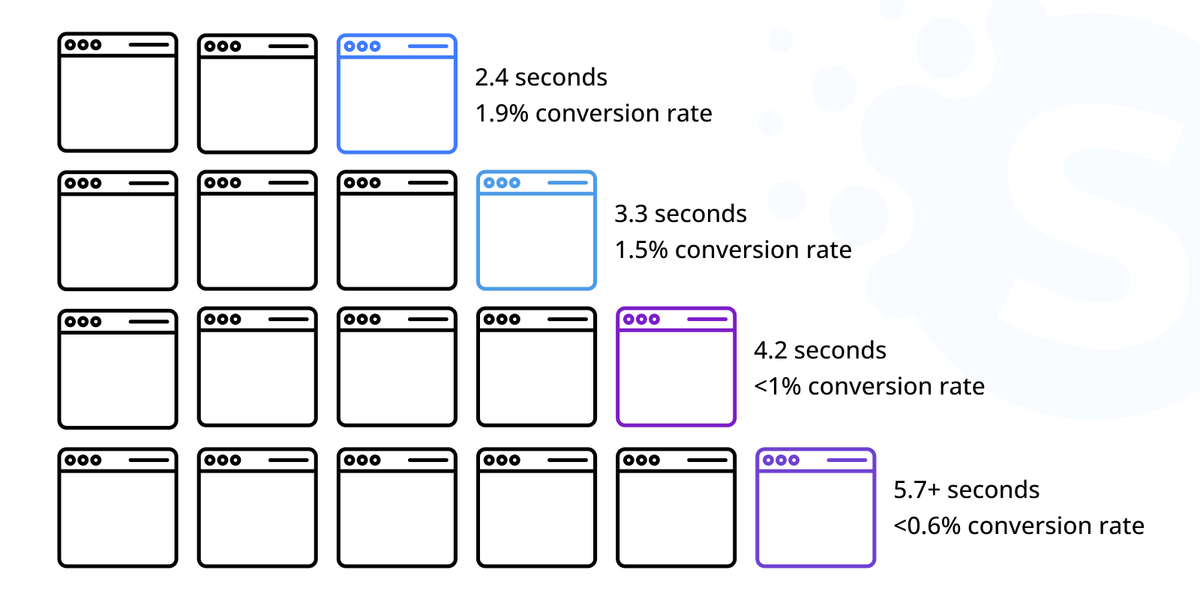
Studies have shown that websites loading in 1 second have 3 times higher conversion rates than web platforms loading in 5 seconds. The difference between the conversion rates of 1-second-loading and 10-second-loading websites is even more impressive. Faster ones have a 5 times higher conversion rate.
For now, you should have no hesitation that you need to care about the website loading speed if you are building a web solution.
In this article, we’ll explain why a single-page app can be a solution to this problem and why such world brands as Pinterest, Google Maps, Gmail, Airbnb, Netflix, and PayPal choose this technology for building their robust web applications.
We’ll also tell you how to make your SPA leveraging our extensive eight-year experience in web development. So, let’s get straight to the point.
Want a skimmable version?
Get a quick overview of our article with AI to access all the important information quickly.
Generate AI SummaryHide summary
Want a skimmable version?
Get a quick overview of our article with AI to access all the important information quickly.
Generate AI SummaryHide summaryA definitive guide to single-page application (SPA) development — what an SPA is, how its architecture works, and SPA vs MPA.
What Is a Single-Page Application?
An SPA framework is a single page where lots of information stays the same. Only a few pieces need to be updated.
You can check examples of single page applications like Trello, Gmail, or Facebook to understand them better.
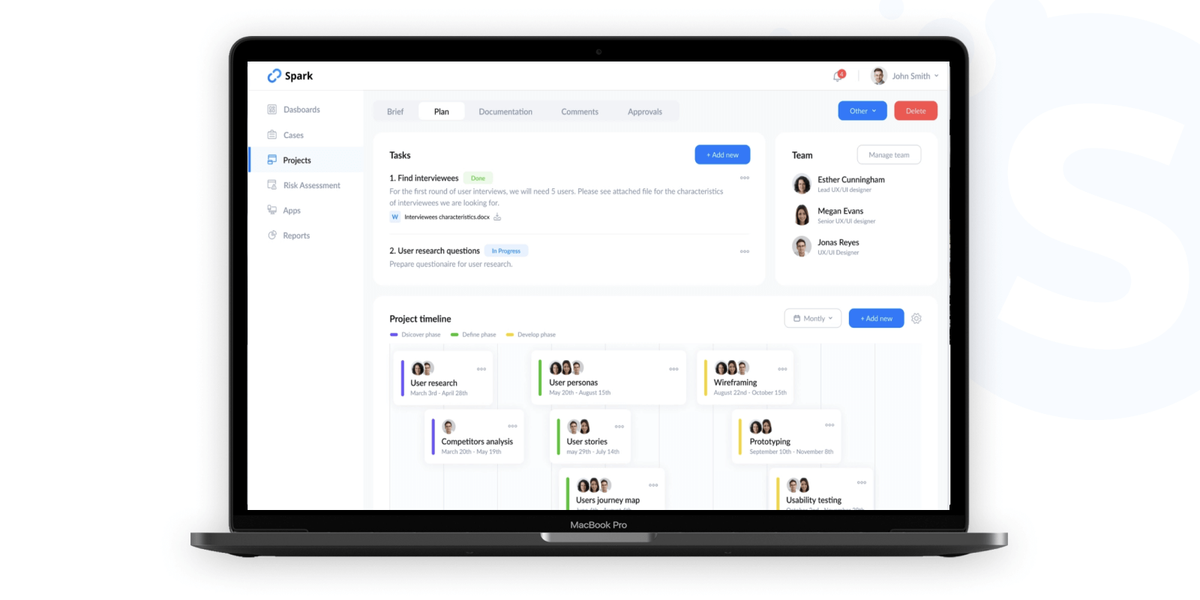
These apps are regularly updated with topical content, but the basic layout will be the same each time you visit.
With each click, this browser-based application sends what you need, and your browser renders the information. It differs from a traditional page load. With conventional page loads, the server must re-render a full page with every click you make and send it to your browser.
The client-side methodology of a SPA makes load time much faster for users. At the same time, there is a lot less information that a server has to send. It is much more cost-effective, so it’s no surprise that developers have become dependent on SPAs.
How Does Single-Page Application Architecture Work?
The best way to understand how SPAs work is to compare them with MPAs. While a multi-page app, or a regular website, requires users to switch between various pages, a SPA provides no interruption of the user experience between pages’ loading. When you interact with SPAs, it might seem like you’re using a simple offline desktop app.
All that is possible owing to a SPA’s architectural structure and work. You may have noticed a lot of similar and stable content on most websites. It’s not highly interactive content but static elements like headers, footers, navigation bars, logos, etc. Many typical layouts and templates, like blogs or self-service sections, are also there. The Gmail setup we mentioned is a perfect example of this.
Choose among 120 software specialists
Hire an offshore dedicated team or a few team members for your project. We guarantee 10% of deviation in deadlines and cost.
Hire a teamA single page application architecture lets you easily navigate the build process. SPAs, if employed properly, are like fully interactive site guides. They work as repeating guides you can use, piping in the proper data and content to fill out each template.
Either way, you’ll see the same tree, but the speed of SPAs becomes evident when you request new content. For instance, if you click on “next,” open mail, or filter results, you’ll get much faster page-loading than if you weren’t using a SPA format.
In MPAs or websites, users switch between separate pages to access the desired content. You can be directed to different areas of a single page almost instantly using a SPA.
Clicking a link or button when you’ve used a SPA setup won’t reload the page. The browser will display the page in a particular state. When prompted, only the requested content will be changed, while the rest remains the same as in the Gmail web app:
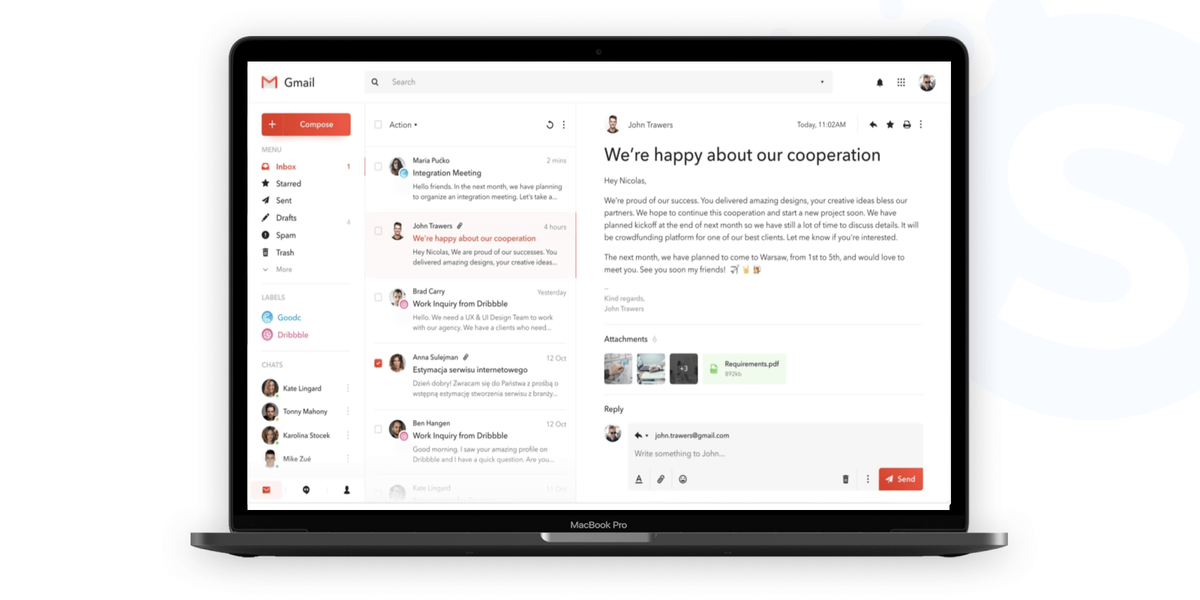
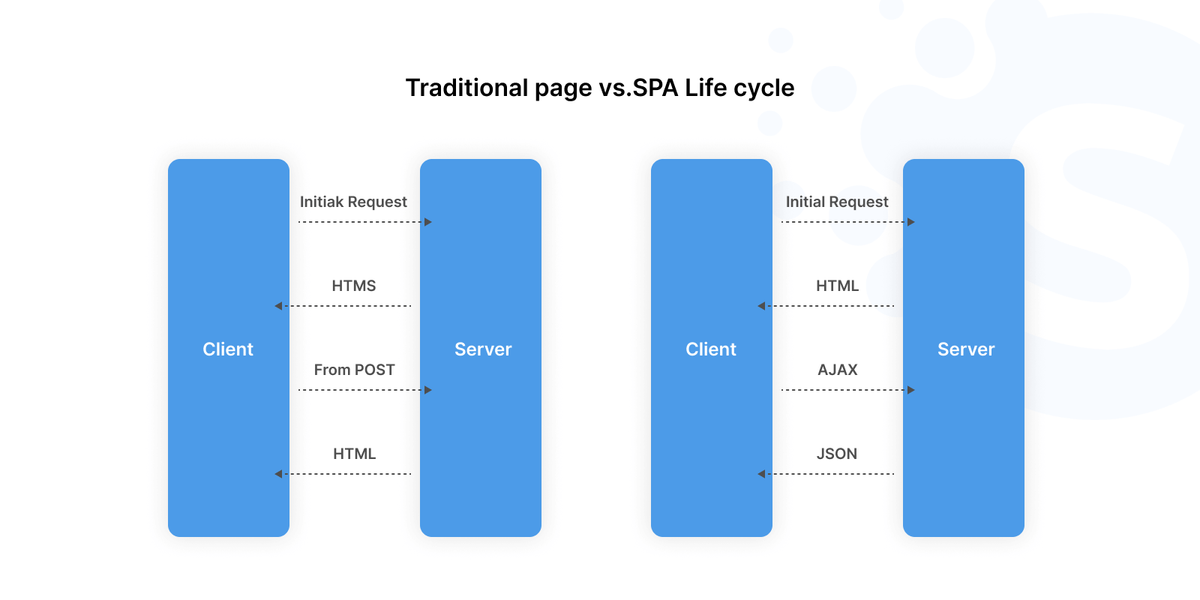
It’s possible thanks to AJAX, which lets the client communicate with the server without reloading the page. A SPA system sends the AJAX request to the server and retrieves JSON data. Then, it renders the required web page parts directly in the browser.
If you look at Trello, Gmail, or your Facebook newsfeed, you will see that they apply the same technology. All these are single-page web solutions that have become extremely popular.
SPA vs. MPA: The Difference Between a Typical Website and Single-Page App
As it has already been mentioned, the best way to understand single-page application development and its work process is to compare it with a typical website. The main differences are SPA’s and MPA’s speed and the options for user experience.
Let’s elaborate on their distinction in more detail, but first, have a look at an illustration below to get a general idea:
Now let’s proceed to the main differentiating factors:
Speed
When you look at a single-page application vs. MPA, you’ll know that speed becomes a key factor. The MPA loads slower and reloads each time the user clicks on any of the buttons, visits another page, or scrolls down the page. That is not the case with SPA. When you load SPA for the first time, the further usage of the app is seamless and faster.
Security
SPAs are prone to hacker attacks. You can improve their security by implementing the right tools, though. MPAs require a thorough approach to protect each separate page of the site. It’s doable, but it is time-consuming and meticulous.
Studies have shown that websites loading in 1 second have 3 times higher conversion rates than web platforms loading in 5 seconds.
The Development Process
One of the advantages of the single-page application is reusable back-end code and entirely separated back-end and front-end parts of the development. The MPA method has many dependencies between the back and front-end.
JavaScript Dependencies
With SPAs, Java dependencies are present. Depending on the version and type of browser you are using, problems might occur with an initial load. If you use an MPA, there is no JS dependency whatsoever.
Link Sharing
The modern SPA features one single link to the entire app. However, deep linking allows you to link to a specific piece of content. With MPA use, a separate link for every page of the MPA is required.
User Experience
The SPA is usually described as being mobile-friendly, responsive, and uninterrupted. The MPA, meanwhile, has better information architecture.
How to Build a Single Page App
Well, you know the key differences between MPA and SPA. Let’s have a quick overview of how to develop a SPA and what pitfalls you might face during this process:
JavaScript and Supporting Frameworks
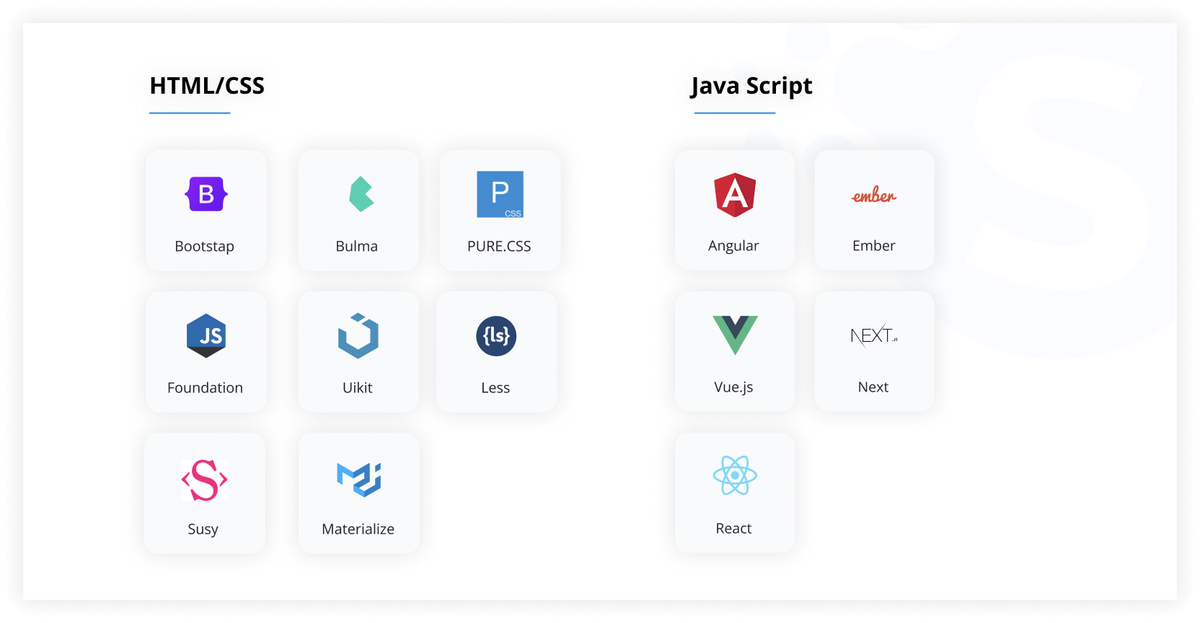
When building your single page application, you must choose an appropriate framework to help reduce development costs while still delivering a high-performance application. There are multiple options from which to choose. You or your development team can use pure JS or try another popular framework, like Vue, Angular, or React.
One of the best and probably not so popular is the Svelte JS framework, perfect for single-page applications and one of the fastest technologies on the market. Besides, other options could be Ember, Aurelia, Angular, React.js, Vue.js, and Meteor.
Read Also: Emerging Digital Technologies Transforming SMEs
AJAX
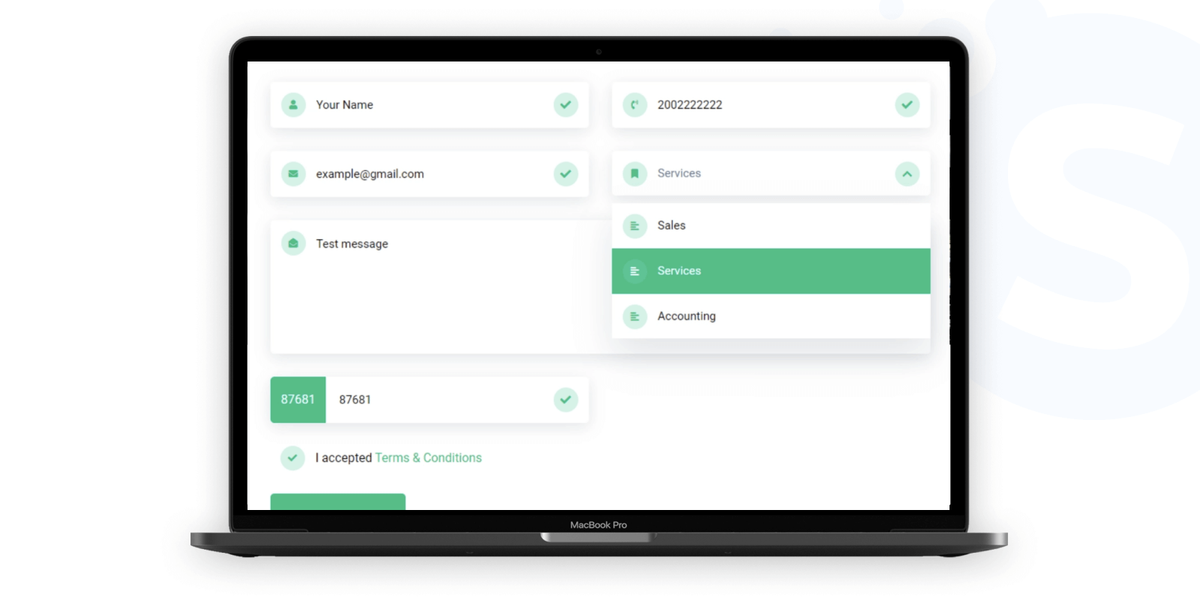
AJAX is used for asynchronous JavaScript and XML. It needs to implement SPA architecture that we, as users, can see as the “unnoticeable” page reload feature. That enables flawless, smooth data exchange between server and client. Here is a simple example of how AJAX works without reloading the page when it has been changed.
Back-End Technologies
One of the benefits of a single-page application is its versatility. Hence, you can choose the back-end technology from multiple options. For example, Node.js is a great option for SPA back-end development. Or, if you prefer PHP, which remains popular, and its frameworks, they are a solid choice for SPA software development.
You might decide to combine Vue.js on the front-end and Laravel PHP framework on the back-end. This combination could be used for clear and straightforward API-driven single-page application development.
Database
You’ll need to compare the existing options and pick the one that will work best for you. It should also be the one with which your SPA developers are most familiar. MongoDB or MySQL are often the best fits.
Read Also: How and Why Integrate Zoom Video Conferencing SDK in Your Website or App
SPA Development Team
It is clear that to implement all the technical solutions we have just mentioned, you need SPA developers. First and foremost, these employees must be proficient in JavaScript.
Typically, your team should consist of the following roles:
- Front-end developers who know JavaScript and work with the interface
- Back-end developers who connect the server part of the SPA with the interface
- UI/UX designers who create a user-friendly visual part of your SPA
- QA specialists who detect any bugs and limitations in your SPA
- A project manager who fully controls single-page application development
SPA Development Time
When building a SPA, you also need to consider development time. The timeline will vary according to your requirements, complexity, number of features, team size, etc. Thus, developing the SPA may take from two to twelve months, after which the post-launch support stage starts.
Single-Page Application Advantages
There are a bunch of single-page application benefits that matter for businesses. Some of those would be improved app consistency and performance and reduced SPA development time and IT infrastructure costs. Let’s make a quick overview of the most crucial single-page applications’ advantages:
Speed and Responsiveness
With single-page applications, a server doesn’t need to reload resources like CSS, HTML, and scripts with each interaction. Such files only require initial loading. After that, the server only downloads new data.
SPAs reload only pieces of content, so they have a lighter server payload. SPAs also reduce response times. It’s because of moving data processing from the server to the browser. That is why these apps allow for fast interactions with users.
The most significant result for the business is that the faster the app, the higher the opportunities to pull ahead of your competitors.
Improved User Experience
Employing a single-page application allows you to deliver faster web apps and create dynamic, fast, and interactive user experiences. As more functionalities are built as modular services that can be updated independently, it becomes easier to experiment with how they are used and displayed.
That results in improved website users’ behavior, like time on site, bounce rate, and higher conversion rate. As you can see, according to Cloudflare’s study, the fastest app means bigger profits.
Reduction of Response Time and Hardware Costs
Single-page apps try to solve poor performance problems and increase conversion rates. If you use them, you can save quite a bit on hardware IT costs.
Faster Development and Testing Processes
Single-page apps can distinguish between data and the user interface. This distinction lets you handle all future integrations and changes in how data enters the SPA framework and goes to other systems with no massive interface implications.
That leads to quite faster development and QA phases. Besides, you can probably achieve the fastest time-to-market by proceeding with building single-page applications according to the rapid SDLC methodology.
Adaptability
A SPA brings you relief when developing a mobile application. That’s because you can reuse the same back-end code from a web-based app for the mobile one. That’s quite challenging with a multi-page application.
Another advantage of SPA is its interoperability. With APIs, the SPAs you build in one language can work easily with back-end services developed in different languages.
Additionally, SPAs look and feel more like applications than websites. You don’t need to specifically adapt SPA functionality or design for mobile devices.
Offline Support and Caching
Single-page applications can also cache any local storage with dispatch. They send one request to a server and store all the data it receives.
The app can use this data. Whenever the connectivity returns, the local data synchronizes with the server. That’s why a SPA can operate when it’s offline, unlike an MPA, so you can keep using it even if your device loses its connection.
The difference between the conversion rates of 1-second-loading and 10-second-loading websites is impressive – faster ones have a 5 times higher conversion rate .
How SPA Benefits Product Owners
As a product owner, it will be much easier for you to manage the development process of a single-page application. It’s all because of the separate SPA layers.
You’ll also benefit significantly from the smooth rollout of updates to your product, helping you outpace the competition and keep users satisfied.
How SPA Benefits Software Developers
In the case of SPA development, the product creation process is faster and smoother. Now two teams can work on creating the front-end and back-end parts simultaneously since the SPA is divided into two layers.
Also, single-page apps are easier to scale. For example, developers can effortlessly integrate new features or prepare the application to serve more users.
Single-Page Application Drawbacks
For all their fine qualities, SPAs do have some disadvantages when compared to multi-page applications. Let’s go over some of those.
Loss of Certain Editing Tools
Marketers are used to having some particular editing tools at their disposal. Some of those tools are present with the MPA model but not with a SPA. If your development team is used to those tools, that might be why to avoid creating a SPA.
Difficulty with Personalization
It’s also valid that SPAs are more challenging to personalize if you want to create an app that is distinctly on-brand. Because they are designed for much of the content to remain static when the page loads, you often have to spend time creating custom templates that utilize the color scheme or graphics that stand for your brand. Some developers feel that this sort of thing is easier with MPAs.
Poor SEO Optimization
Since SPAs work on JS loading data upon request from the client, they lose search engine optimization functionality. Unchanging URLs mean a lack of unique addresses for different pages.
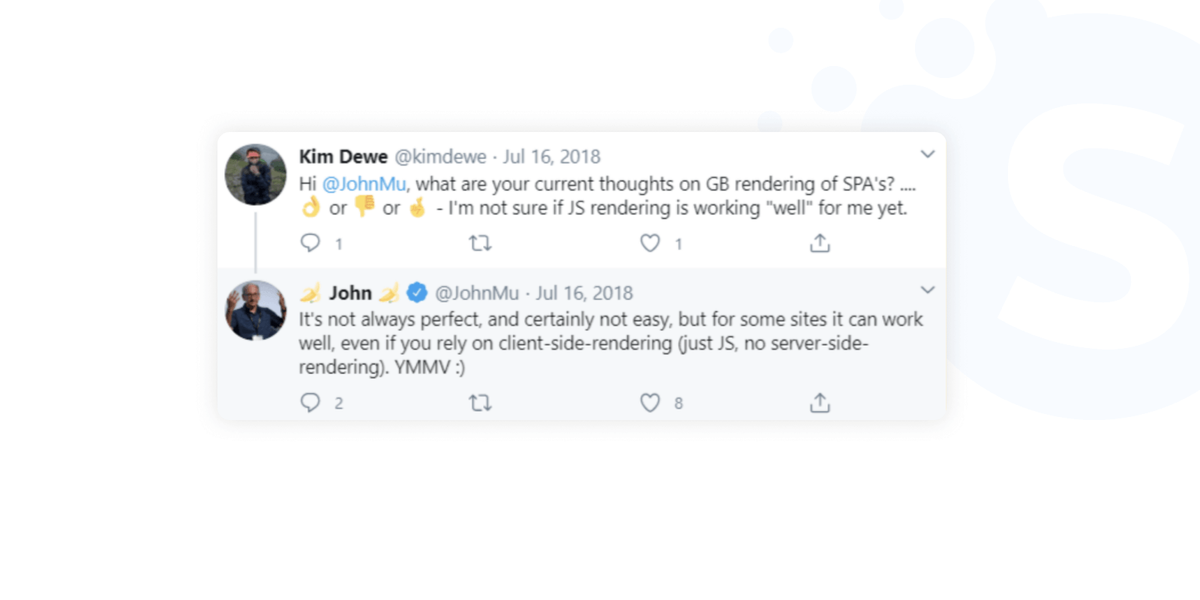
It means that trying to optimize such a site for search engines becomes genuinely challenging. Besides, optimization of such an app might be complex, though the majority of SPAs get indexed well by Google according to Google Webmaster Trends Analyst explanation:
Poor Link-Sharing Capabilities
SPAs have a single URL address. That makes sharing bigger pieces of content a more complicated process from the development perspective, so linking is not as simple as with MPAs.
Difficult Analytics Tracking
Analytics tools rely heavily on entire new pages loading in browsers, initiated by a new page load. SPAs don’t work this way.
It’s possible to add page load events to a SPA using the HTML5 history API. It will help integrate analytics. The problem arises when trying to ensure that everything is being tracked accurately.
So when you add the Google Analytics tracking code, you need to pay more attention to the code integration than the usual website. Some frameworks provide open-source analytics integrations that address most major analytics providers.
When to Create a Single-Page Application
Considering SPA’s pros and cons, this kind of app might not be the best match for some cases. So let’s examine some when it’s better to launch a SPA instead of a simple website:
You Wish to Build a Native-Like Browser Experience
A SPA is a setup through which you can build a high-functioning app that runs smoothly on any device and in any browser. The SPA system provides a chance to create a mobile app base while, at the same time, you can offer a native-like app experience that will work in popular browsers.
You Want a Fast, Dynamic Platform that Won’t Handle Lots of Data
Let’s say that you want to get your app’s high responsiveness and speed, but you don’t need your website to be high-load. If that’s your situation, then a SPA is ideal for your needs.
You Need Fast Results
If you need to launch your app as fast as possible, a SPA will be the way. Single-page application development allows you to launch a responsive website much faster.
Hence, the SPA is a great choice for MVP development. After that, you can collect user feedback and validate your app idea, whether it is successful or not to develop the entire website. So with SPA, you can grow your business much more rapidly than if you chose to implement MPA.
You Want Impressive Client-Side Functionality
A rich, user-oriented interface generates attention and makes visitors stay on your website. It’s also helpful in getting them to take specific actions.
You Have a Ready-Made API
If there is an API for public or internal use, you can use the SPA method to build it instead of trying to reproduce the needed logic with an MPA.
Conclusion
Generally speaking, any website can become a SPA. A SPA setup will work for you if you plan on creating SaaS platforms, social networks, storytelling websites, closed communities, or landing pages.
Now, you know what a single-page app means, its pros and cons, how it differs from MPAs, what its development process is, and when it’s better to use this kind of app.
Besides, if you are going to develop your product but are still unsure what model to choose, contact our team and get our quote on web app development.
You should have no hesitation that you need to care about the website loading speed if you are building a web solution .
Frequently Asked Questions
How do I produce a single page application?
It would be best if you assembled a development team first. Your SPA developers must be proficient in JavaScript and its frameworks, AJAX, and databases. These employees will handle all the technical tasks for you.
How much does it cost to develop a SPA?
Even though the single-page application development is quite straightforward, it will still take time and resources. So, expect it to cost anything from $10,000. For more precise calculations, contact our team.
How long does it take to create a single-page application?
It depends on your final requirements for the SPA. If your app doesn’t have extensive functionality, it will take about two months to develop. For more complex SPAs, your team will require six to twelve months.
Does your team provide single-page app development services?
Yes, the Softermii team can accomplish this task. We are experienced in web development and offer various web solutions, including SPAs.
How about to rate this article?
582 ratings • Avg 4.6 / 5 · Thanks for rating!
Written by:

Co-Founder
Andrii Horiachko is a Co-Founder of Softermii with over 12 years of experience in software development, eight of them spent building and managing Softermii itself. He is responsible for technology-innovation in clients’ projects, making sure every product runs on a modern, carefully chosen tech stack that can sustai…