


Telemedicine Market Trends and Statistics for 2024

Want to know more? — Subscribe
In this article, you will read about telemedicine trends and get insights regarding telemedicine's future, considering the industry's current state.
In this article, you will read about telemedicine trends and get insights regarding telemedicine's future, considering the industry's current state. Telemedicine adoption is accelerating rapidly. Recent surveys indicate that 80% of patients have received care through virtual channels at least once. As telehealth becomes integral to healthcare delivery, demand grows for user-friendly platforms and intuitive design.
Seamless integration with existing systems is also a priority. Patients and providers value consolidated access to scheduling, video visits, chat, records, and more within a single portal.
Softermii stays abreast of the latest healthcare IT advancements. We have successfully launched fully-featured telehealth apps HIPAA Telmed and MedRealtime. They offer appointment tools, reminders, EHR connectivity, and more for clients.
Want a skimmable version?
Get a quick overview of our article with AI to access all the important information quickly.
Generate AI SummaryHide summary
Want a skimmable version?
Get a quick overview of our article with AI to access all the important information quickly.
Generate AI SummaryHide summaryTelemedicine market trends and statistics for 2024 — adoption, regional growth, and the key trends.
Telemedicine Market Statistics: Key Insights & Adoption
The growth of the telemedicine market started in the 2000s, and in 2023, it was valued at $114.98 billion. It is estimated that the number will reach $141.19 billion by 2024 — and an astonishing $380.3 billion by 2030.
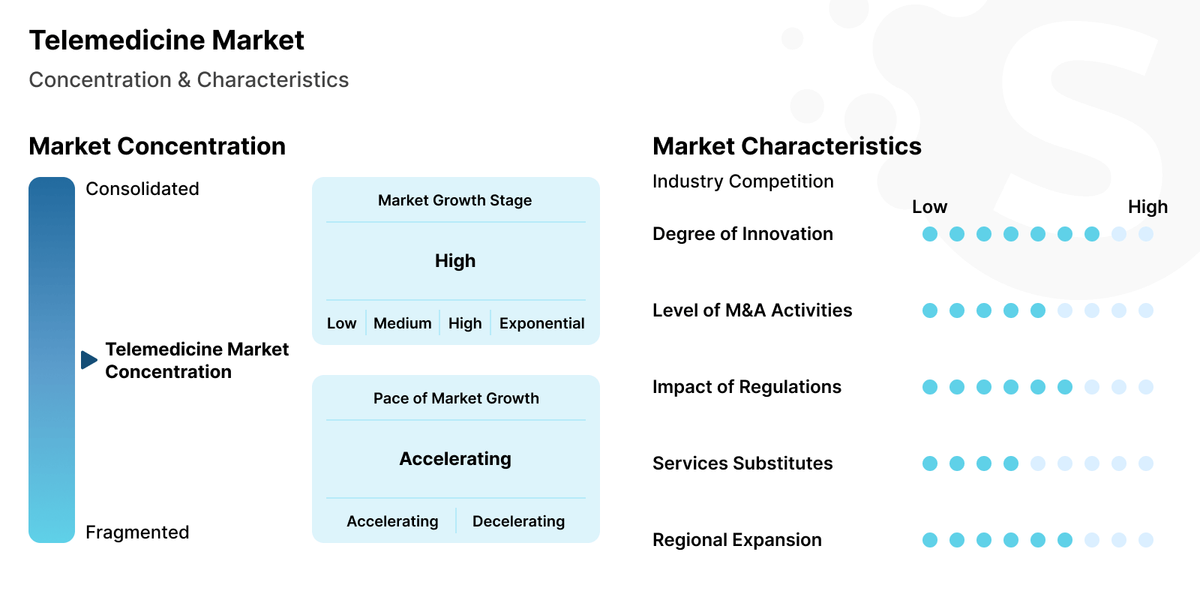
Telemedicine Usage Statistics in Regions and Growth Projections
You can see the phenomenal growth of telemedicine in different regions. North America remains one of the leading regions for telemedicine development.
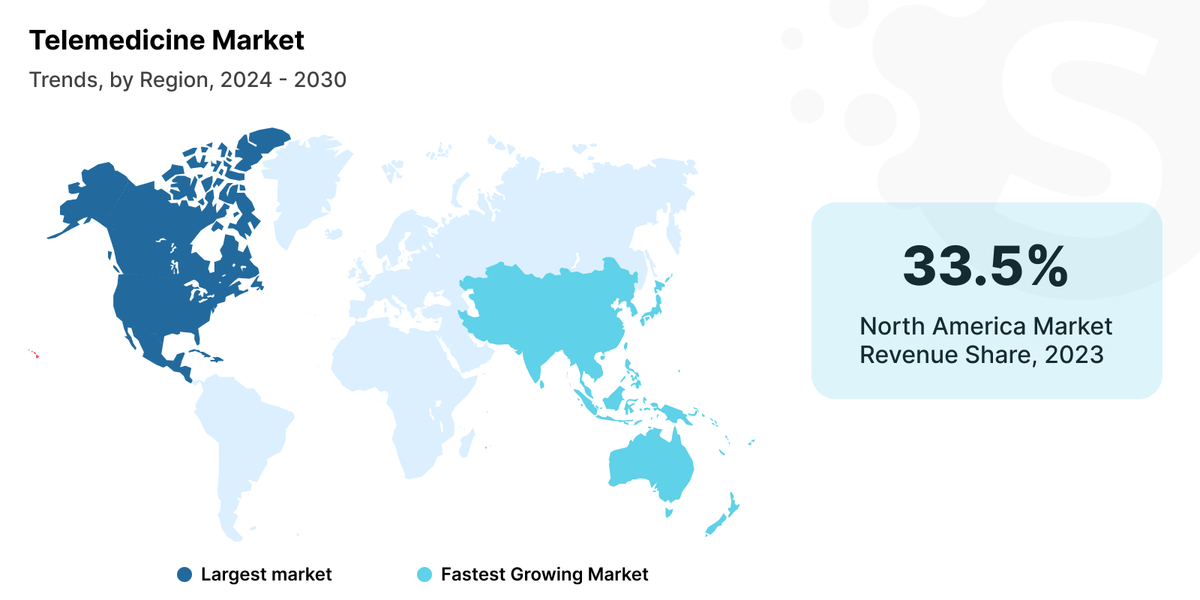
Europe is also experiencing a new telemedicine era: the market, estimated at $12.9 billion in 2023, will reach $24.84 billion by 2028.
Current Telemedicine Market Trends
According to research by Mordor Intelligence, the telemedicine market is poised to grow from approximately $151.42 billion, with a CAGR of 13.88%, to reach $290 billion in 2028.
The telemedicine industry trends market is divided into three main segments by the source of healthcare: Telehospitals, Telehomes, and Mobile Health. All three niches of the industry are expected to grow.
1. Telehome
Telehome, also known as Telehomecare, is an industry term for home-administered healthcare and health monitoring. It's one of the largest trends in telemedicine of the past year.
The largest market driver boosting this trend is the growing number of chronic diseases — 6 in 10 US adults have at least one. This need for better, more comprehensive continuous treatment, combined with technological innovations, results in new services being offered and more patients expecting convenience in the services offered to them.
At the same time, more Americans in rural areas, the ones with the most difficult time accessing quality care locally, have reliable connections to the internet that allow them to receive this type of care.
Fully committed dedicated team
We identify your needs and turn them into successful software solutions
Hire a team2. Telehospitals
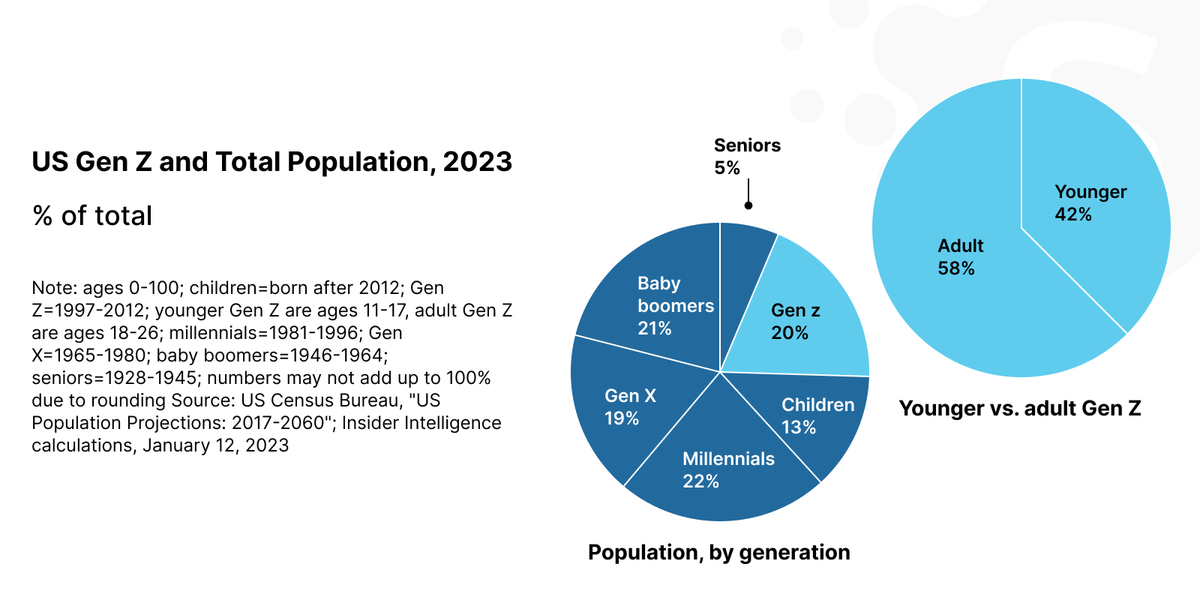
22% of the population in the US consists of millennials, aged 27 to 42. Together with Gen Z, they are the most tech-friendly and tech-savvy generations. Both of them present a unique market for telehospitals to increase further, and it's likely to stay one of the recent trends in telemedicine for 2024 and beyond.
3. Mobile Health
One of the largest telemedicine trends in healthcare, in general, is making health more accessible. Mobile healthcare is perhaps the broadest term in the telehealth industry, encompassing everything from apps that help users conduct breathing exercises to connecting to healthcare professionals directly.
The most significant market driver boosting mHealth is the popularity of smartphones and tablets. They become smarter and can connect to more medical devices, consolidate that data, send it to doctors, or even synthesize a likely diagnosis.
Read also: Psychological Therapy App Development
4. Chronic Care Management
Chronic care management is one of the biggest trends that are changing telemedicine. According to the latest research, chronic diseases are the leading cause of death worldwide. Thus, telemedicine needs to take this issue under control.
Management of chronic care via telehealth reveals new opportunities for the healthcare industry. For example, cost reduction and patient engagement. In return, this will cause better control over chronic diseases and a decreased number of deaths.
5. Focus on Mental Health
With the COVID-19 situation worldwide, the approach to telemedicine has changed. The biggest changes are noticed in mental health practices. There's a growing emphasis on integrating mental health EHR solutions into telemedicine platforms for comprehensive care.
In 2019, the prevalence of telehealth services for mental health and substance use in outpatient care was 39.4%. The pandemic gave a significant boost to telehealth, leading to a remarkable increase. According to the latest research, the availability of these services has surged to 88.1%.
6. Improved UX
With the quick growth and development of the industry, customers expect that the app's design will become better. Improved UX of telemedicine applications has been one of the biggest telehealth market trends in 2023 and will still be trendy in 2024.
Clear navigation, necessary features depending on the role of the customers, and quick access to key features: it's vital to follow industry best practices and implement the newest approaches.
Key Telemedicine Future Trends to Know
The growth of telehealth presupposes a rapid growth of existing trends and the development of new ones. Here are the future healthcare technology trends that will keep changing the industry shortly.
1. IoT and IoMT
The Internet of Things is nothing new, and collecting health data using an external device isn't, either. However, a growing telehealth market trend is about connecting more devices with a specific goal of improving health, such as glucose monitors, nutrition monitors, mobility data, etc.
It enables healthcare professionals to make better decisions using more accurate and up-to-date data. It's not necessarily a new way to serve healthcare that Telemedicine purports to be, but rather an enhanced way of facilitating healthcare administration.
2. Artificial Intelligence, Machine Learning, and Big Data
The full potential of AI and ML is yet to be found, especially as they concern healthcare. This trend in telemedicine will continue to grow and develop well into the future. AI and ML help with advanced medical imaging analysis, stroke prediction, personalized treatment, and more.
With the advent of Big Data, solutions that can identify viable health trends and perform forecasting based on telemedicine statistics will pave the way for in-depth research providing previously unavailable insights into society's healthcare needs.
Generative AI and LLM
Generative AI in healthcare can create personalized health education content and interactive experiences. They provide customized informational material, interactive health management guides, and virtual coaching sessions.
In mental health care, LLMs can offer preliminary counseling and help in crisis intervention. These technologies can also analyze continuous streams of patient data from wearables and other remote monitoring devices. Thus, they can predict potential issues before they become critical, enabling proactive care.
3. AR and VR
These technologies promise to benefit patients dealing with serious health issues, including helping stroke victims overcome their limitations and supporting patients with dementia or cognitive impairments. Robotic surgery is another area of healthcare that benefits from augmented reality technology. The field is expected to experience substantial growth in the next few years and reach almost $58.1 billion by 2028.
4. EHR-Embedded Solutions
Embedding a patient's electronic health record (EHR) in telehealth solutions is important to use the information productively. Yet, integrating their EHR systems with telehealth solutions is still a promising field for software developers.
The security issue is one of the larger ongoing telemedicine future trends right now, and EHR integration is a massive piece of the puzzle. The security of individuals' health-related information will become more important as EHR-embedded solutions become more widely available. Applications need to be built to prioritize data security to protect sensitive information.
A significant reason for the reluctance to use telemedicine solutions is the perception of the lack of security, propelled by the recent deluge of news related to security breaches.
5. HL7
Health Level 7 is not a new trend in telehealth but a growing one, especially due to the data security issue discussed above.
It's a telecommunications standard used internationally to facilitate data transfers between healthcare applications at all levels, including healthcare administration programs.
As telehealth becomes integral to healthcare delivery, demand grows for user-friendly platforms and intuitive design.
6. Internet of Behaviors
IoB goes one step beyond ML, AI, and Big Data to combine information from various sources, including behavioral data from internet usage and more, to develop recommendations for better health choices for the end-user.
Similar existing algorithms in social media, digital advertising, the insurance industry, and the banking system have shown that human behavior can be predicted and changed significantly. And improving human behavior is the key to improving health.
7. Integrated Data Sharing
A customer should have the option to visit any hospital, doctor, or pharmacy and get the same level of service. For the healthcare industry, it's vital to track and control all information, from the latest treatments to operations and diseases.
Integrated data sharing makes the information available to all hospitals and clinics. Therefore, a customer does not need to provide it every time they have an appointment with a new doctor.
8. Remote Monitoring
Remote monitoring reduces the number of offline visits to the hospital or clinic and still controls the patient's health.
Remote monitoring may use wearable technology to control basic life indicators. Yet, the most important thing is that remote monitoring allows you to share this information with your therapist. Therefore, you can get treatment when your therapist notices changes in your indicators. Read our incredible guide on how to develop remote patient monitoring software.
9. Investment in Technology
The biggest future trend in telemedicine is investing in technology. Clinics, hospitals, and pharmacies are ready to spend more on telehealth development, but the situation will change in the near future.
If you plan to use telemedicine actively, be ready to invest in the newest technologies.
10. Better Data Security
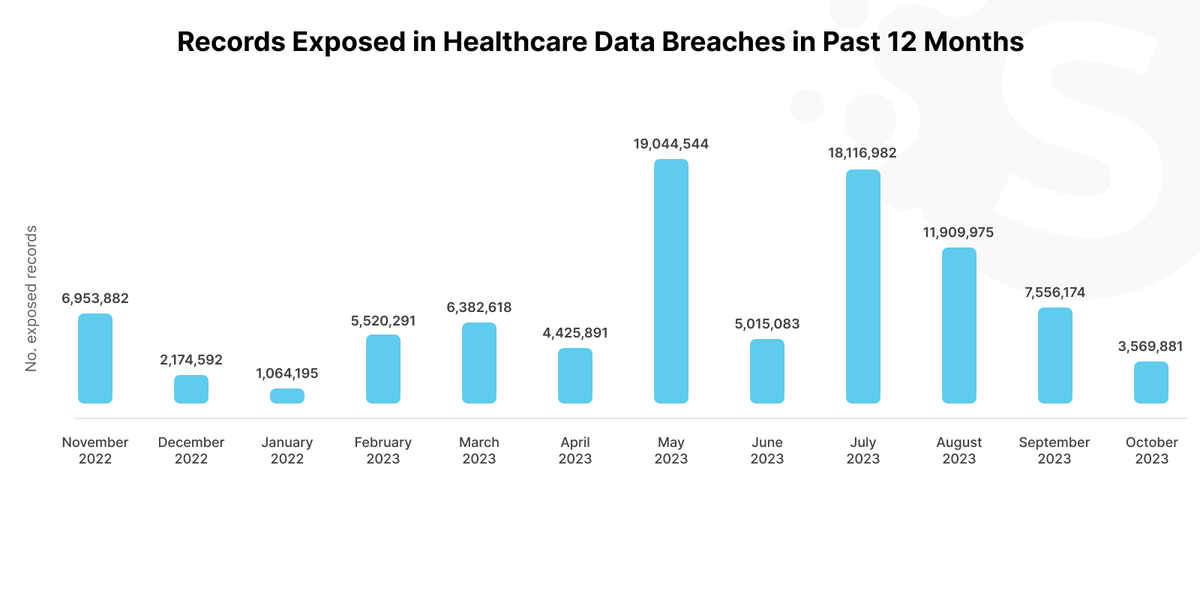
In 2023, more than 500 healthcare institutions reported healthcare data breaches. The data leakage affected about 82.6 million individuals. It's a significant increase compared to 51.9 million in 2022. Given the growing number of health data breaches, data security remains a trend for 2024 and beyond.
Challenges of Telemedicine Trends Implementation
Despite the impressive telemedicine growth statistics and increased telehealth adoption, implementing healthcare tech is not without obstacles. There are still some challenges to overcome to make the industry thrive.
Implementing Telemedicine in Existing Legacy Systems
Some hospitals and other healthcare institutions are hesitant to implement telemedicine in their processes. The reasons for this are the fear that technologies will disrupt the current workflows and the lack of the necessary infrastructure for adopting telehealth.
Training Remote Healthcare Providers
Implementing the recent trends in telemedicine also necessitates educating medical staff on how to use these technologies. It may become another barrier to the adoption of telehealth.
Understanding the Healthcare Institutions' Unique Needs
Each healthcare organization has specific technology needs. Thus, some existing telemedicine programs, which are more like out-of-the-box solutions without adjustment to the health facilities' requirements, may not be the best implementation cases. In this regard, hospitals must assess their needs and look for telemedicine providers to meet them.
Complying with Regulatory Requirements
Providing telemedicine services in a particular region can be challenging, considering all the regulations. If telemedicine providers decide to expand the area of their services, they will face new legal requirements to meet. It can become an obstacle to implementing telemedicine programs and may leave some patients out of reach.
$114.98 billion
The growth of the telemedicine market started in the 2000s, and in 2023, it was valued at $114.98 billion .
Softermii's CEO Takeaway
If you take away one thing from our telehealth market forecast, let it be this: the industry is walking in seven-league boots. Telehealth statistics concerning usage and adoption rates are impressive. After the 2020 adoption curve, the best time for businesses that want to get in on the growing trend was yesterday, and now it is the second best.
Softermii Experience
New and existing businesses that want to capitalize on current telemedicine trends in healthcare industry need an experienced partner to guide them through the intricacies of such development.
Softermii has the necessary experience to bring your idea to market. We have a proven track record of success, as seen in these case studies highlighting our work on the HIPAA Video and MedRealtime projects.
Partnering with developers experienced in building solutions for the healthcare industry is a great strategy for companies breaking into the lucrative telehealth market. They will have already addressed many issues that will materialize during product development and streamline project completion.
HIPAA Telmed

HIPAA Telmed is our telemedicine application that helps conduct video conferences and ensures better communication between patients and doctors.
Challenges
Development of an application that improves communication and reduces healthcare costs in the US and the entire world. Implementation of legacy technologies to create a HIPAA-compliant app.
Read also: Cost of Telemedicine Software
Solution
Implementation of WebRTC, TSL, TDL, and Role-based Authorization technologies allowed us to comply with all HIPAA regulations and create multi-peer video conference connections.
Basic features
- Full-HD real-time video streaming
- HIPAA compliance
- Portable device compatibility
- Security encryption of all data
- Appointment scheduling
- Whiteboard functions
- Read more here
MedRealtime
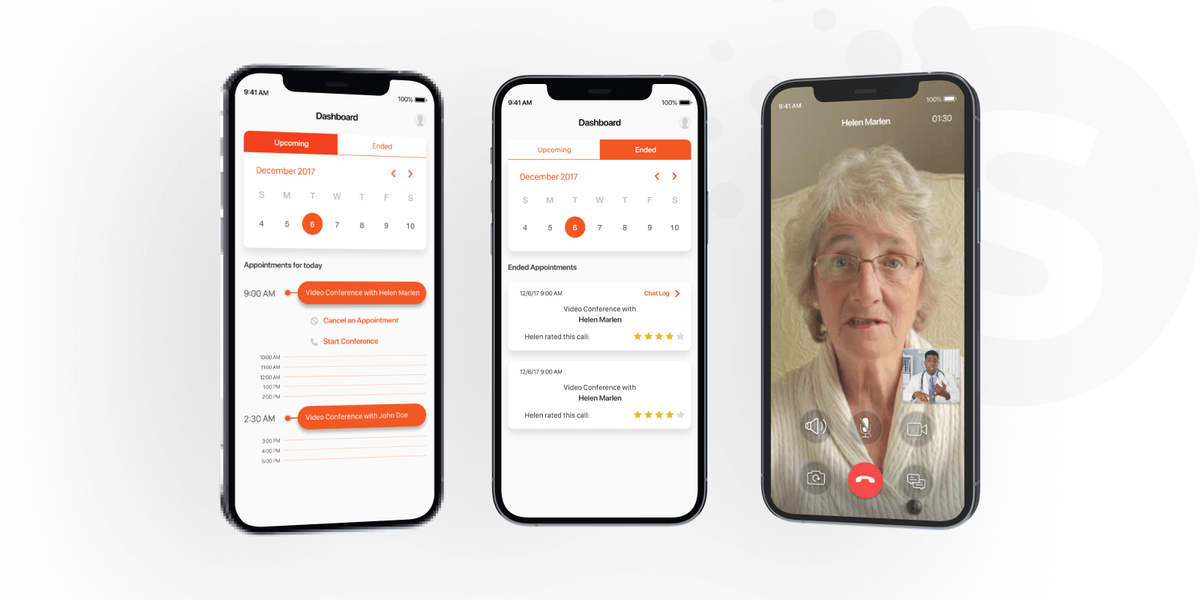
MedRealtime is an online application developed by Softermii that helps to host real-time video consultations, schedule appointments, and send reminders to doctors and patients.
Challenges
The development of the application simplifies appointment booking and consultation payments while making data management effective for physicians. Optimization of hospital workloads. Creative, efficient solutions for patients and doctors.
Solution
Implementing the latest technologies helped create an HD-video conferencing platform for private and secure video consultations, integrated messaging, online & offline appointment booking with real-time synchronization of the doctor calendar, and automated reminders.
Basic features
- Map integration
- Secure video and a messaging room built-in NAT, Firewall, and encrypted protection
- Only PIN-access
- Secure payments gateway
- Synchronization of the platform with other internal office solutions
- Read more here
Final Thoughts
Technology has transformed healthcare delivery and access. Telemedicine and virtual care have enabled more convenient, timely connections with providers. Online communication platforms have vastly improved over recent years.
Developing user-friendly, effective telemedicine services requires specialized expertise. Softermii offers experience building customized video conferencing and eHealth solutions tailored to clients' needs. We welcome the opportunity to apply our development capabilities to advance your organization's virtual care offerings.
We can help you integrate platforms that enrich patient experiences, enable healthcare provider efficiency, and facilitate optimal care. Our team is ready to discuss how upgraded platforms can take your remote healthcare services to the next level. Contact us to explore the digital healthcare possibilities!
In a post-pandemic world, telemedicine has become one of the key services that cover the needs of a large number of people.
Frequently Asked Questions
What was the value of the global telemedicine market in 2023?
The growth of the telemedicine market started in the 2000s, and in 2023, it was valued at $114.98 billion. It is estimated that the number will reach $141.19 billion by 2024 — and an astonishing $380.3 billion by 2030.
The growth of the industry is supported by telemedicine market trends that are rapidly developing and growing, interest in the industry itself, and rapid growth of online applications.
How is the global telemedicine market fragmented?
Telemedicine growth statistics also demonstrate the growth in telemedicine segments. According to virtual healthcare trends, teleradiology, telepathology, telecardiology, telepsychiatry, telemonitoring, and teledermatology keep growing. For sure, these are the emerging trends in telemedicine.
It seems that telemedicine was created to disrupt the common healthcare industry. There's no need to visit your cardiologists to understand what's going on with you: everything can be done online.
How much is the global market worth?
As telehealth growth statistics show, by the end of 2024, this number will reach over $141.19 billion. Still, growth projections can be adjusted as the industry demonstrates rapid growth.
If we compare telemedicine trends for 2023 and 2020, we will see a huge difference. Industry analysis shows that Covid-19 has had a huge impact on telemedicine, and obviously, it will be changing.
What are the key factors driving the market?
Telemedicine's future trends are driven by the rapid growth of technology and Covid-19. The telemedicine technologies market has collected the world's newest and most effective approaches.
Telehealth trends in the healthcare industry prove that telemedicine is the first industry that experiments with those innovations when the online development market changes.
How about to rate this article?
1127 ratings • Avg 4.6 / 5 · Thanks for rating!
Written by:

CEO & Co-Founder
Slava Vaniukov is the CEO and Co-Founder of Softermii, with more than 10 years on the front lines of software development. He has spent that decade helping founders and enterprises turn ambitious ideas into products that ship — and that perform. Apps built by his teams have been featured on multiple “Top 10 Best App…