
How to Tell a Real AI Development Agency From Agent-Washing (Before You Sign)

Want to know more? — Subscribe
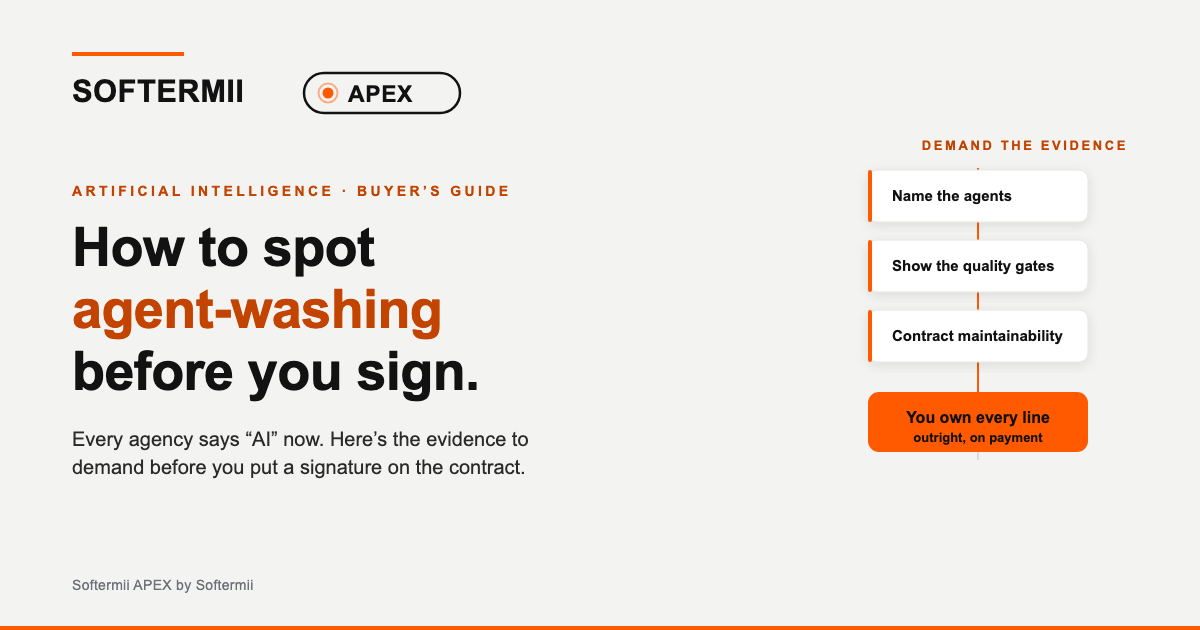
Every software agency now says "AI." Here are 7 questions and the red flags that tell a real AI development agency from agent-washing — before you sign.
Every software team you might hire now leads with the same two letters: AI. Agents, copilots, automated testing, "AI-native delivery." Some of it is real and changes what a small team can ship. Some of it is a slide.
The problem is that from the outside, on a sales call, the two look identical. Both say “agents.” Both promise speed. And the gap between them doesn't show up until months later — in a codebase your team can't maintain, a bill that kept growing, or an “owner” you can't find when something breaks.
So before you sign anything, you need a way to tell the real thing from the theater. This is that guide: what agent-washing is, the seven questions that expose it, and the red flags that mean walk away.
Agent-washing, defined
Marketing AI-agent delivery a vendor can't actually show — no named mechanism, no governance you can inspect, and no contract that makes the AI's output their responsibility instead of your inheritance. The term was popularised by Gartner: an “AI agent” label on workflows that are neither autonomous nor accountable.
What agent-washing actually is
Agent-washing isn't that the AI is fake — it's that the discipline underneath is optional and invisible from a demo. The productivity is genuinely real, so everyone adopted the language; the governance that makes it safe is where vendors quietly differ. Two findings frame the risk you're taking on.
| Signal | What the research found | What it means when you're buying, not coding |
|---|---|---|
| Google DORA 2025 | More than 80% of developers say AI raises their productivity — yet about 30% distrust the AI-generated code itself | The speed is real, and so is the instability, unless someone is accountable for governing it |
| GitClear 2026 | Across hundreds of millions of code changes, duplicated blocks are up sharply since 2023 while refactoring — the work that keeps code maintainable — is declining | More copy-paste, less cleanup: cheap to launch, expensive to change later — a cost that lands after the invoice clears |
Speed is not the hard part anymore. Maintainability and accountability are — and that is exactly where agent-washing hides.
Why this matters more than it sounds
The risk isn’t that the AI is "fake." It’s a codebase that arrives fast and is expensive to own — a cost that lands on you six months after the invoice cleared. Speed you cannot maintain is not speed.
Under the marketing, every buyer is really asking three quiet questions: Is the code any good, or just generated quickly and left for someone else to untangle? Will my team be able to own it after handover, or am I locked into whoever built it? And is my code or data being used to train someone’s model? A vendor doing real AI delivery answers all three with evidence. A vendor that’s agent-washing answers with adjectives.
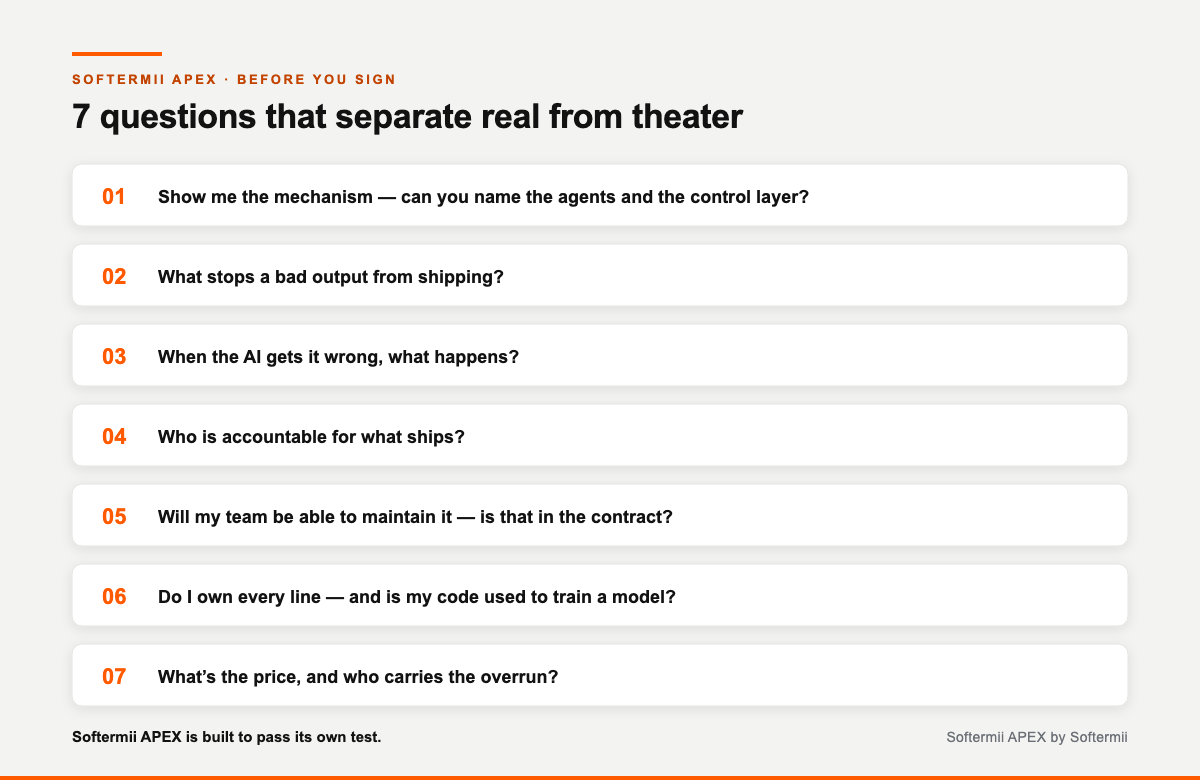
The 7 questions to ask before you sign
For each one: what a weak answer sounds like, and what a strong answer looks like. Bring this list to the call.
| # | The question | Weak answer (a tell) | Strong answer (evidence) |
|---|---|---|---|
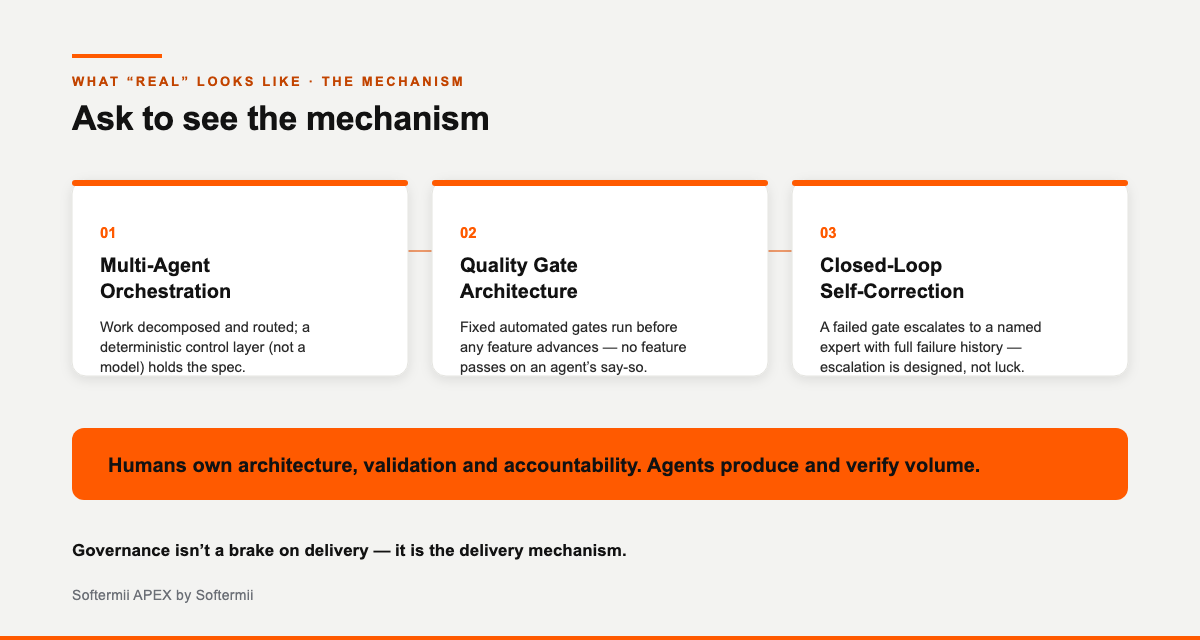
| 1 | Show me the mechanism | "It’s proprietary — we can’t get into how it works" | They name the agents and a deterministic control layer (not a model) that holds the spec as the single source of truth |
| 2 | What stops a bad output from shipping? | "Our seniors review everything" (at what volume, against what?) | Fixed automated quality gates every feature must pass before it advances — spec, static analysis, dependency/licence, secrets, tests, security, complexity |
| 3 | When the AI gets it wrong, what happens? | "It self-corrects" — unbounded, no human | A bounded corrective loop that escalates to a named expert with full failure history — escalation is designed, not luck |
| 4 | Who is accountable for what ships? | A fuzzy "the team," or worse, "the AI" | A named human owns architecture, validation and accountability; agents produce and verify volume |
| 5 | Will my team maintain it — is that in the contract? | "It’ll be clean code" (a promise, not a clause) | A measurable maintainability standard verified at handover: a new engineer can build, test and deploy from the docs alone |
| 6 | Do I own every line — and is my code used to train a model? | Ownership "on our platform," a licence-back, or a shrug | You own every line outright on payment, no licence-back; AI on enterprise terms with a zero-retention posture |
| 7 | What’s the price, and who carries the overrun? | "It depends on the hours" (you carry the estimation risk) | One fixed price agreed before work starts, with the vendor absorbing its own underestimates |
Red flags vs. green flags
If you want the whole thing on one screen, here it is.
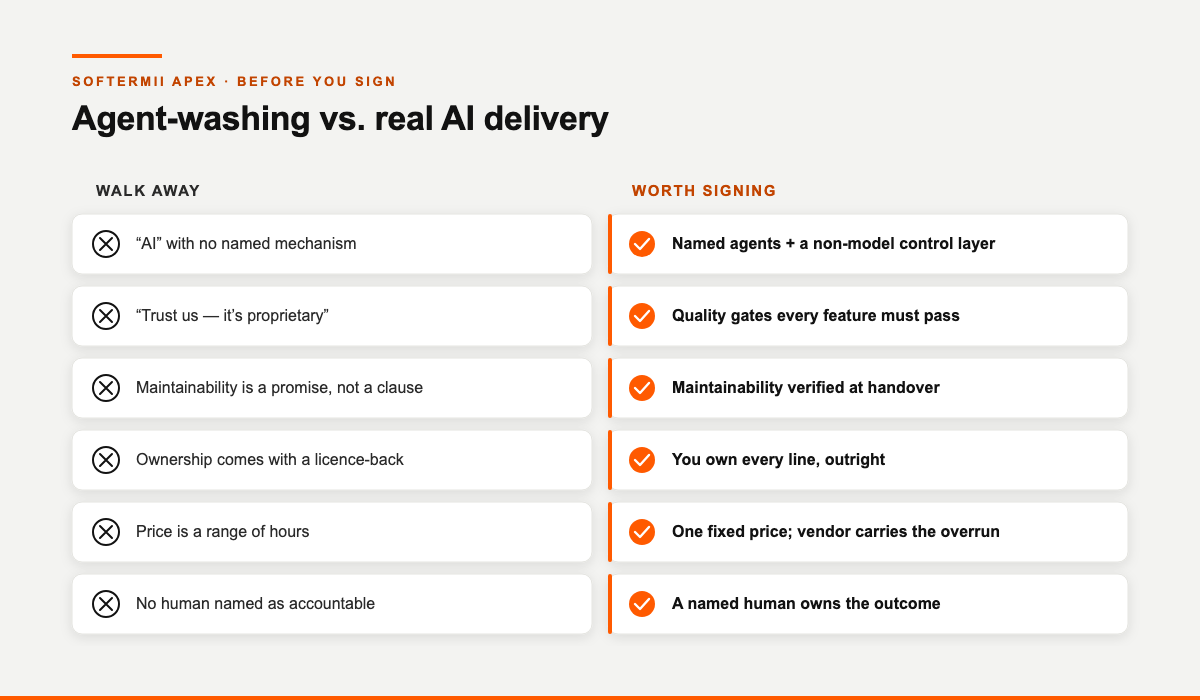
| Walk away | Worth signing |
|---|---|
| "AI" with no named mechanism | Named agents + a non-model control layer |
| "Trust us — it’s proprietary" | Quality gates every feature must pass |
| Maintainability is a promise, not a clause | Maintainability verified at handover |
| Ownership comes with a licence-back | You own every line, outright |
| Price is a range of hours | One fixed price; the vendor carries the overrun |
| No human named as accountable | A named human owns the outcome |
A note for the technical reviewer
If you’re the CTO, VP Eng or security reviewer being asked to bless the choice, push one level deeper: ask for a task-level breakdown of how a feature moves through the agents, ask to see the agent components demonstrated rather than described, and ask for the data-handling posture in writing — model provider and commercial terms, retention, access controls, and whether AI decision logs are available on request. A vendor doing the real thing will welcome those questions. A vendor that’s agent-washing will try to move the conversation back to the demo.
The honest part: when you don't need any of this
Not every project needs a governed AI-delivery vendor, and a good one will tell you so. If you have a strong in-house team and a stable roadmap, hire — don’t outsource. If your scope changes weekly by design, buy hours (time-and-materials) — a fixed price will fight you. If you just want to validate a rough idea this weekend, use a builder tool — genuinely.
This vetting matters when you’re buying a defined outcome you intend to own — real, production-ready software at a price you can trust — and you want to be sure the "AI" delivering it is a mechanism, not a message.
Where Softermii APEX fits
We built Softermii APEX — Softermii’s agentic AI engineering engine and expert-led delivery model — to pass exactly the test above: named AI agents under a deterministic control layer; fixed quality gates before any feature advances; a closed loop that escalates to a named human; maintainability contracted and verified at handover; you own every line; and one fixed price agreed before we start, with us absorbing our own underestimates.
The governing rule we hold ourselves to
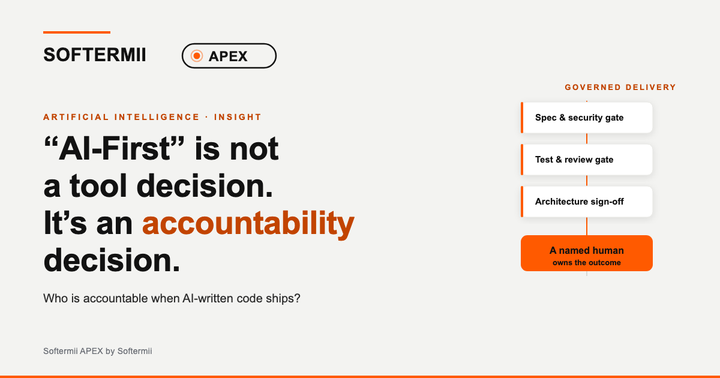
Humans own architecture, validation and accountability. Agents produce and verify volume. Governance isn’t a brake on delivery — it is the delivery mechanism.
Evaluating AI software partners?
Get your free itemised estimate — a named, Feature-level breakdown at a fixed price, within 24 hours. You see the budget. We absorb the unknowns.
Get your free itemised estimateFrequently asked questions
What is agent-washing?
Agent-washing is marketing AI-agent delivery a vendor can't actually demonstrate — no named mechanism, no inspectable governance, and no contract making the AI's output their responsibility. The term was popularised by Gartner.
How do I know if an AI agency's agents are real?
Ask them to name the agents and the layer that controls them. Real agent delivery has a deterministic orchestration layer (not a model) that holds the spec as the single source of truth, plus automated quality gates every feature must pass. "Proprietary, can’t explain it" is the tell.
Is AI-generated code maintainable enough for my team to take over?
It can be — but only if maintainability is contracted, not promised. Insist on a measurable standard (duplication ceiling, coverage floor, complexity ceiling, architecture decision records, dependency hygiene) verified at handover, with the bar being that a new engineer can build, test and deploy from the documentation alone.
Who owns AI-generated code?
Whoever the contract says. Insist on owning every line outright on payment, with no licence-back and no dependency on the vendor's engine — and confirm the AI runs on enterprise terms so your code isn't used to train a model. How the code was created shouldn't affect who owns it.
Fixed price or time-and-materials for an AI build?
If the scope is defined and you want price certainty, a fixed price agreed before work starts — with the vendor absorbing its own underestimates — puts the estimation risk where it belongs. Time-and-materials suits work whose scope changes weekly by design.
- #agent-washing
- #AI development agency
- #AI governance
- #AI code ownership
- #agentic AI
How about to rate this article?
0 ratings • Avg 0 / 5 · Thanks for rating!
Written by:

Co-Founder
Andrii Horiachko is a Co-Founder of Softermii with over 12 years of experience in software development, eight of them spent building and managing Softermii itself. He is responsible for technology-innovation in clients’ projects, making sure every product runs on a modern, carefully chosen tech stack that can sustai…