

Your automation layer wasn't built for your AI agents to run

Want to know more? — Subscribe
The real cost of no-code automation isn't the subscription — it's the hidden hours, the silent failures, and an automation layer your AI agents cannot run.
Operations and growth teams are hitting the same wall right now. You have spent years wiring your business together with a no-code automation platform — Zapier, Make, n8n, one of them. Hundreds of small workflows moving data between your CRM, your billing, your product, your inbox. And now you are putting AI agents to work inside the same business. That is where the two worlds stop fitting together.
Ask an agent to check why last night's lead never reached the CRM. It can't. Ask it to disable a workflow that is firing twice, or to fix one that broke when an upstream API changed. It can't do that either. Everything about that automation layer lives behind a web console built for a person to click through — not for software to read, operate, or repair.
That is the real reason teams are leaving. Not the bill. The bill is just the part you can see.
The short version, if you're weighing whether to move off a no-code platform: the real cost of no-code automation is not the subscription. For a mature automation estate the fully-loaded total — subscription, plus the weekly hours a team spends fixing silently-broken workflows, plus the revenue lost to failures nobody caught — often exceeds $10,000 a month, and the subscription is the smallest part.
And the deeper reason teams move for their AI agents: a click-only, black-box automation layer can't be read, operated, or repaired by software. Agents can't list your workflows, see which one failed, or switch a bad one off. Only owned, agent-maintainable integrations give them something they can monitor and fix.
The real cost of no-code automation is the part you can't see
Line up what a mature automation estate actually costs, and the subscription is usually the least of it. There are three layers, and only one of them shows up on an invoice.
1. The subscription. At real task volume, a serious plan runs anywhere from a few hundred to a few thousand dollars a month. Visible, predictable, and the cheapest part of the picture.
2. The manual hours. Someone on your team spends part of every week finding automations that silently stopped, re-running failed tasks, and rebuilding a workflow after a connected tool changed. It rarely sits with one owner; it is spread across ops and marketing as "the thing I deal with on Monday." It never appears as a line item, which is exactly why it grows.
3. The silent failures. The most expensive layer and the hardest to see: the lead that never reached sales, the churn signal that never triggered the save email, the invoice that never synced. You don't get an alert. You find out from the outcome, weeks later.
You're not imagining the scale of this. In Salesforce's 2025 MuleSoft Connectivity Benchmark, IT teams reported spending 39% of their time on custom integration work — and that's before the ops-and-marketing hours in the table below.
Here is the same idea as a model you can run on your own numbers. These figures are illustrative — swap in yours.
| Cost layer | Illustrative monthly figure | Where it lives |
|---|---|---|
| Automation platform subscription | $800 – $3,000 | On the invoice |
| Team hours fixing/replaying broken automations (≈40 hrs/mo across ops + marketing, at your fully-loaded cost) | $2,500 – $4,000 | Hidden in payroll |
| One meaningful silent failure (a batch of leads or a billing sync that didn't run) | $3,000 – $8,000+ | Never counted |
| Fully-loaded total | often $10,000+ / month (range $6,300 – $15,000+) | Mostly invisible |
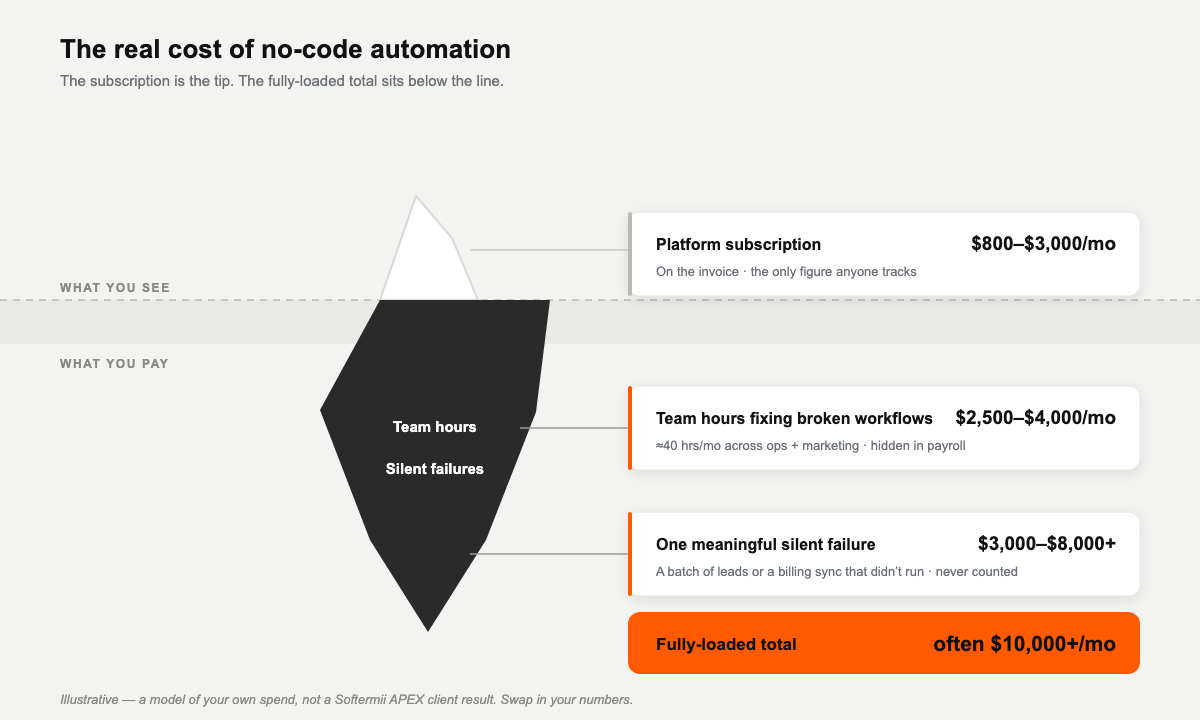
The point is not the exact number. The point is that for most teams the fully-loaded cost crosses $10,000 a month, and the subscription — the only figure anyone tracks — is a fraction of it. You are not overpaying for the tool. You are paying, over and over, for the work of keeping a black box alive.
Why no-code automation breaks in an AI-run business
No-code automation platforms were a good answer to a real problem: connect two tools without waiting on engineering. The trouble is that the assumptions they were built on are the exact ones an AI-run operation breaks.
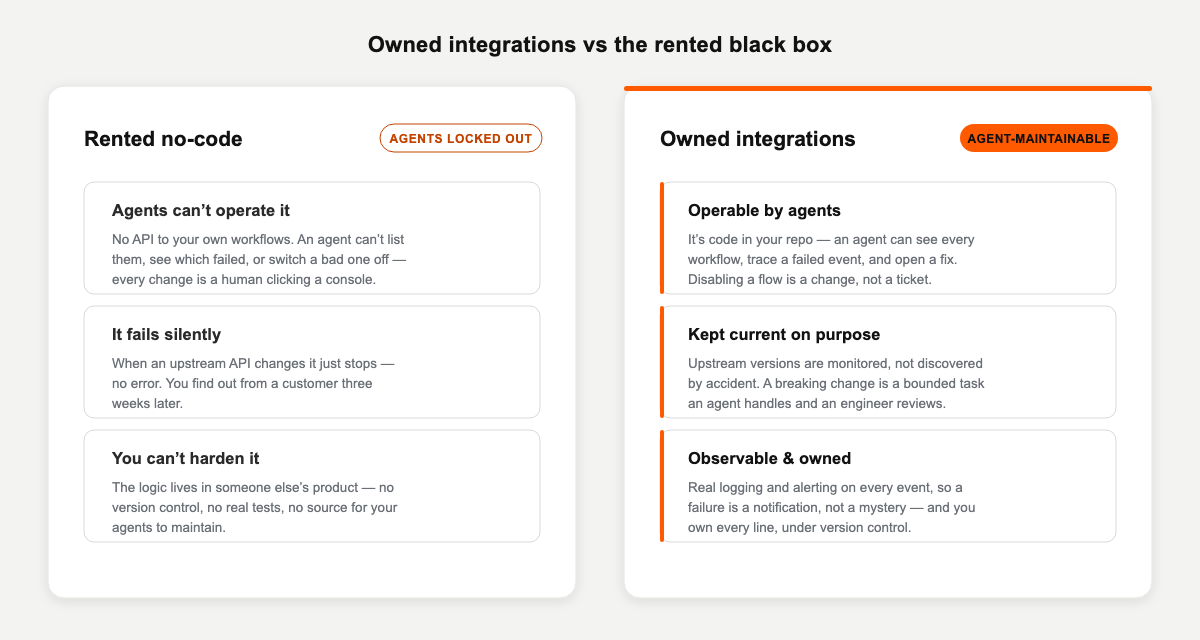
- There is no way for your agents to operate it. No first-party API to your own workflows, no command line, no readable definition of what runs when. An agent can't list your automations, see which one failed, or turn a bad one off. To change anything, a human clicks through a UI. Your agents are locked out of the automation layer your business quietly runs on.
- It fails silently, and staying current is your problem. When a connected service ships a new API version, the automation doesn't warn you — it just quietly stops doing what it used to. Say your payment processor deprecates the API version your billing sync depends on: the workflow doesn't throw an error, it just stops writing invoices, and you find out from a customer three weeks later. Nobody is watching the version; a person eventually notices the symptom and rebuilds the workflow by hand. Multiply that across hundreds of workflows and dozens of tools that each change on their own schedule.
- You don't own it, so you can't harden it. The logic lives in someone else's product. You can't put it under version control, can't add real tests, can't give your agents the source to maintain. When the platform changes pricing or a connector, you adjust to them.
None of this is a knock on the tools. It is a mismatch. A layer designed to be clicked by a person cannot be run by software — and in an AI-run business, more and more of the running is done by software.
Owned integrations vs Zapier: what agent-maintainable automation replaces it with
The alternative is not "hire a team and hand-code everything forever." It is to turn the rented, click-only workflows into owned integrations that are just code — code your AI agents can read, monitor, update, and repair, under expert supervision. That flips all three problems:
- Operable by agents. Because the integration is code in your repository, an agent can see every workflow, trace a failed event end to end, and open a fix. Disabling a misbehaving flow is a change, not a support ticket.
- Kept current on purpose. Upstream API versions are monitored, not discovered by accident. When a provider ships a breaking change, updating to the new version is a bounded task an agent handles and an engineer reviews — instead of a silent outage you find out about from a customer.
- Observable and owned. Real logging and alerting on every event, so a failure is a notification, not a mystery. And you own every line — under version control, tested, yours to change without anyone's permission.
The economics move with the ownership. The subscription goes away. The weekly firefighting — the hidden, biggest cost — goes away, because the maintenance is done by agents watching the pipeline instead of people reacting to it. What's left is the other side of the ledger: a one-time build, then ordinary running cost on infrastructure you control — hosting plus supervised agent maintenance. So the honest comparison isn't "subscription vs. build." It's staying (that fully-loaded total, every month, indefinitely) versus owning (a one-time build amortised against a much smaller monthly run cost). Put your own numbers on both sides before you decide.
What moving off no-code actually looks like
You don't switch everything off on day one. The workable path is incremental, not a big-bang cutover:
- Rank your workflows by value and fragility. The handful that move real money or break most often get rebuilt first; the simple, stable ones can stay on no-code as long as you like.
- Rebuild the top ones as owned code, running in parallel. The new integration runs alongside the existing workflow and you compare their output until it matches — nothing is switched over until parity is proven.
- Retire the old workflow once the owned version is trusted, then work down the list at whatever pace suits you.
Because it's incremental and verified against what you already run, there's no day where the business is flying blind. And what you keep versus rebuild is your call — a mature estate rarely needs 100% moved; it needs the load-bearing 20% owned, observable, and maintainable.
Building integrations that stay agent-maintainable
There's a catch worth naming: owned code only pays off if it's genuinely maintainable. Otherwise you've swapped a rented black box for one you built yourself. Getting that right — production-grade, secure, and documented well enough that a new engineer or an agent can run it — is the hard part, and it's the job Softermii APEX exists for.
Softermii APEX is a proprietary agentic AI engineering engine: you describe the integrations and automations you need, Softermii breaks them into an itemised list of Features, and specialised AI agents build, test, and harden them while named Softermii experts own the architecture and stay accountable for what ships. You see working software in week one. The price is fixed and agreed before a single line of code is written — the number you approve is the number you pay — and you own every line on payment.
The part that matters most here — maintainability — isn't a hope; it's contracted and verified at handover: a duplication ceiling, a test-coverage floor, documentation good enough that an engineer new to the project can build, test, and deploy from the docs alone. That's what makes the integrations stay agent-maintainable long after delivery, so you own an asset your team keeps running — not a new black box you can't touch. And because it's your code, it runs in your own cloud environment: credentials and data stay under your control, not inside a third-party console.
You can see the payoff in the work. On one build, the client reported at handover that the delivered codebase was structured and documented well enough for their internal team to take over development without a rebuild — which is the whole point of an owned integration layer. (For the wider track record: 30+ products launched, 85% of them in under four weeks, and Softermii's Clutch profile rated 4.9/5.0 across 48 verified reviews as of September 2026.)
When a no-code platform is still the right tool
If you run a handful of simple, stable automations — a form that emails a notification, a nightly export nobody depends on for revenue — a no-code platform is the right tool and you should keep it. The subscription is cheap and there is nothing for an agent to maintain. Owning has a real cost of its own, too: you take on the hosting and the maintenance discipline, and for a brand-new one-off connector, a no-code platform is genuinely faster to stand up tomorrow. If you have no engineering supervision at all and only a few stable flows, stay rented.
This shift is for you if:
- you run dozens or hundreds of workflows, not a handful;
- real money moves through them — billing, leads, revenue signals;
- someone on your team already loses hours every week keeping them alive; and
- you're putting AI agents to work and want them to actually run the operation.
If that's you, the useful next step is to get that layer scoped and priced before your next renewal — a defined build, at a fixed price, owned by you. That's the case Softermii APEX is built for.
The takeaway
Leaving a no-code automation platform was never really about the subscription. It is about who — or what — gets to run your operations. If your automations can't be seen, operated, or repaired by the agents you're putting to work, you are paying twice: once on the invoice, and much more in the hours and the silent failures the invoice never shows.
Owned, agent-maintainable integrations turn that rented, click-only layer into code your team controls and your agents keep current. Softermii APEX builds it for a fixed price, hands it over with maintainability contracted and verified, and leaves you owning every line.
Scope your integration layer before your next renewal
Get your free itemised estimate — a Feature-level scope of your integration layer, delivered within 24 hours. No call required to get the number.
Get your free itemised estimate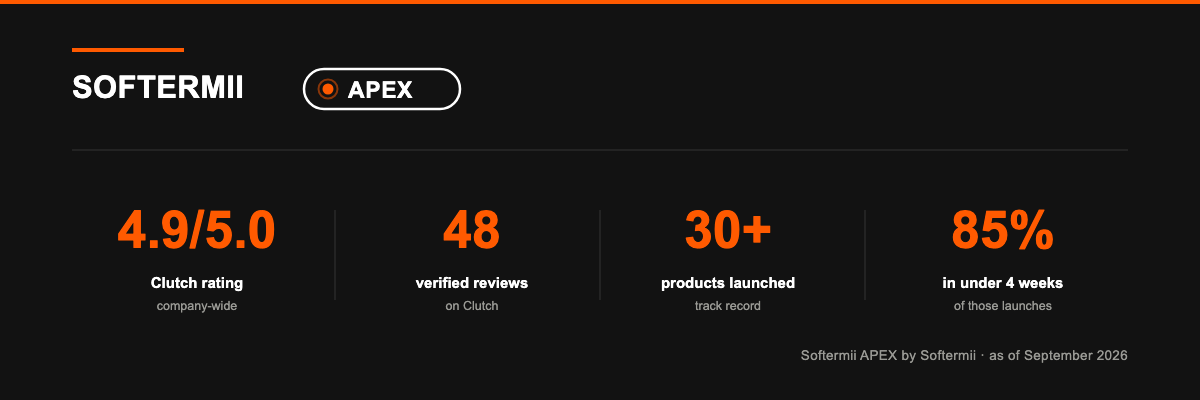
Frequently asked questions
What's a good Zapier alternative for AI agents?
Instead of a hosted no-code platform, teams are moving to owned integrations built as code in their own repository — workflows an AI agent can read, monitor, and repair directly. Softermii APEX is one way to get that layer built for a fixed price, with every line handed over to you.
What's the real cost of no-code automation?
The subscription ($800–$3,000/month at real volume) is the smallest part. Add the team hours spent fixing silently-broken workflows and the revenue lost to failures nobody caught, and the fully-loaded cost for a mature estate often crosses $10,000 a month.
Should I replace Zapier if my automations are simple?
No. For a handful of stable, low-stakes workflows a no-code platform is the right tool — the subscription is cheap and there is nothing for an agent to maintain. The shift pays off only when the layer is load-bearing: dozens of workflows and real money moving through them.
What makes an integration "agent-maintainable"?
It lives as owned code under version control, with real logging, tests, and documentation good enough that an engineer or agent new to the project can build, test, and deploy from the docs alone — so agents keep it current instead of a person rebuilding broken workflows by hand.
Owned integrations vs Zapier — what actually changes?
You trade a rented, click-only black box for code you own and control: agents can operate and repair it, upstream API changes are monitored rather than discovered from a customer complaint, and there is no subscription or connector lock-in.
Can AI agents manage or fix Zapier workflows?
Not really. Zapier, Make, and n8n expose no first-party API to your own workflows and no readable definition of what runs when, so an AI agent can't list your automations, see which one failed, or disable a broken one — every change goes through a human clicking a web console. Owned integrations, built as code, are the thing an agent can actually operate and repair.
What is Softermii APEX?
Softermii APEX is an agentic AI engineering engine from Softermii, a software development company. You describe the software or integrations you need; specialised AI agents build, test, and harden them while named Softermii experts own the architecture — delivered as production-ready code you own outright, for a fixed price agreed up front.
How much does Zapier cost at scale?
At real task volume a serious no-code automation plan runs from a few hundred to a few thousand dollars a month ($800–$3,000) — but that subscription is the smallest part of the fully-loaded cost, once you add the team hours spent fixing broken workflows and the revenue lost to failures nobody caught.
- #Zapier alternative
- #no-code automation
- #owned integrations
- #agent-maintainable automation
- #AI agents
How about to rate this article?
0 ratings • Avg 0 / 5 · Thanks for rating!
Written by:

Chief Operating Officer
Maksym is one of the few operations leaders who has personally done nearly every job he now oversees. Across 15+ years he rose through the full stack of software delivery — QA → Business Analysis → Product → COO — building QA, BA, Design, and engineering functions from scratch at Netcracker Technology (including rol…