
AI Agents in Logistics: Use Cases, ROI & How to Deploy Them (2026)

Want to know more? — Subscribe
AI agents in logistics: the six highest-ROI use cases, honest benchmarks, single vs multi-agent architecture, and a proven staged path from pilot to production.
Logistics runs on decisions — thousands of them a day, most still made by people staring at dashboards. Which carrier, which route, which load, what to do when a shipment slips. AI agents change that: instead of reporting that a delivery is late, an agent detects the delay, evaluates alternatives, rebooks, and notifies the customer — on its own, for routine cases.
This guide is for logistics and supply-chain leaders, VPs of operations, and CTOs who already believe AI belongs in their operation and now need the practical picture: where agents deliver real value, what the returns look like, and how to deploy without becoming another stalled pilot. Gartner expects more than 40% of agentic AI projects to be canceled by the end of 2027 — usually not because the technology fails, but because the delivery approach does. This is the exception path: the use cases that pay off, the returns you can realistically expect, and the delivery discipline that separates production systems from abandoned pilots.
TL;DR
- AI agents act, they don't just report. A traditional TMS tells you a shipment is late; an agent reroutes it, rebooks the carrier, and updates the customer.
- Six high-value use cases: dispatch optimization, dynamic routing, demand forecasting, carrier intelligence, exception handling, and returns/reverse logistics.
- The returns are real but conditional. Published benchmarks put AI route optimization at up to ~15% lower transportation cost and ~10% lower emissions, with forecast-accuracy gains of 20–50%. Your results depend on data quality and workflow fit.
- Architecture must match the problem. Single-agent for one clear task; multi-agent when steps are interdependent. Over-engineering is the more common — and more expensive — mistake.
- Most failures are delivery failures. Skipping validation, underestimating data work, and treating agents as a one-time build sink the majority of projects.
- Delivery discipline beats model choice. A staged path — validate the riskiest assumption first, then build, operate, and scale — is what actually gets agents to production. (It's also how we structure delivery at Softermii.)
What is an AI agent in logistics?
An AI agent in logistics is software that pursues a goal autonomously: it observes live data, reasons about options, takes an action, and learns from the outcome — with humans setting objectives and reviewing exceptions rather than approving every step.
That's the difference between the systems most teams run today and what's coming. A transportation or warehouse management system (TMS/WMS) records and manages operational data. It's rule-based: useful, but rigid, and it waits for a human to act. An agent operates on that same data continuously and decides. The industry distinction is simple: a TMS tells you a shipment is late; an AI agent detects the delay, evaluates alternative carriers, initiates a rebook within your rules, and notifies the customer — without human involvement for routine cases.
This is often described as Tier 3 (agentic) automation — as opposed to Tier 1 rule-based scripts that break on edge cases, and Tier 2 assistants that still need a human at every critical juncture. The leap in operational leverage comes from agents handling exceptions and coordinating with other systems, not just surfacing recommendations.
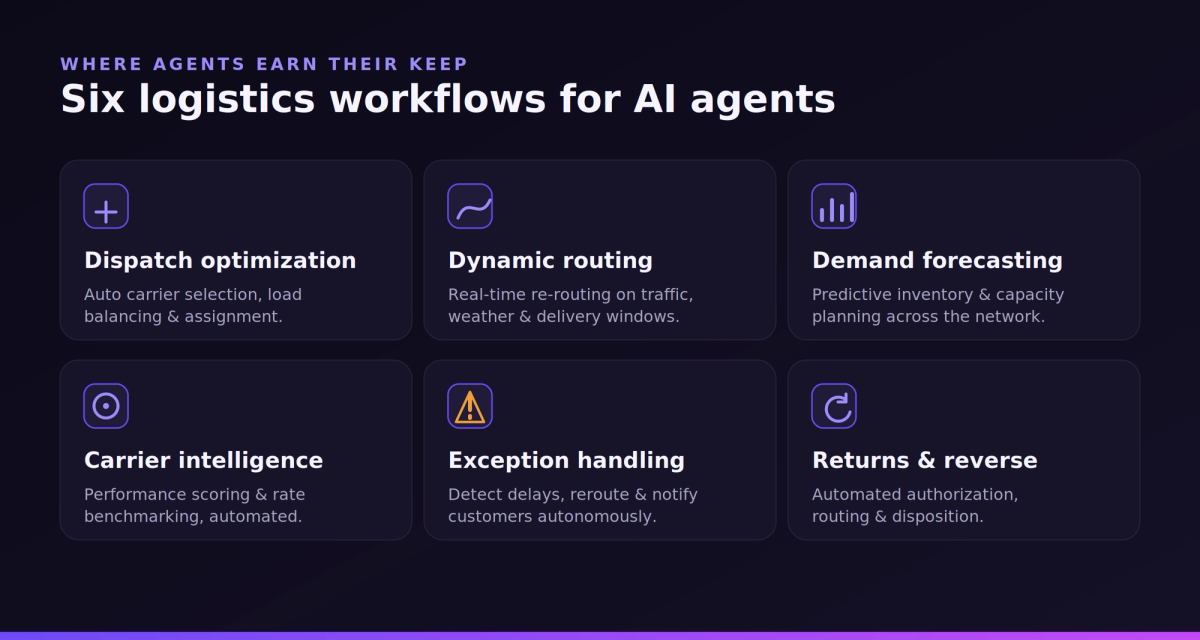
Six logistics use cases where AI agents earn their keep
Not every workflow deserves an agent. These six are consistently strong candidates because they happen frequently, generate the data agents learn from, and carry measurable cost.
1. Dispatch optimization. Automated carrier selection, load balancing, and assignment based on real-time capacity, cost, and historical performance — decisions a human dispatcher would need hours to make well, generated in seconds.
2. Dynamic route optimization. Continuous re-routing against live traffic, weather, delivery windows, vehicle capacity, and driver hours-of-service. Vehicle routing with time windows is a genuinely hard computational problem, which is why static daily routes waste an estimated 15–25% of fuel and driver time.
3. Demand forecasting. Predictive models that place inventory and capacity ahead of demand, reducing both stockouts and waste across the network.
4. Carrier intelligence. Automated performance scoring and rate benchmarking across your carrier network, so selection is data-driven rather than habitual.
5. Exception handling. The highest-leverage everyday use case: detect delays, reroute shipments, and notify customers automatically — turning a reactive scramble into a resolved event.
6. Returns & reverse logistics. Automating return authorization, routing, and disposition (refurbish, resell, recycle, dispose). Reverse logistics typically costs 2–3× more per item than the forward journey, so automation here compounds fast.
Each of these maps to a capability we build into production logistics systems — see our logistics software development services for how they fit together.
The ROI picture: what AI agents actually move
The honest version: the numbers are strong, but they're benchmarks, not guarantees. Published Gartner and McKinsey analyses of logistics networks point to a consistent pattern.
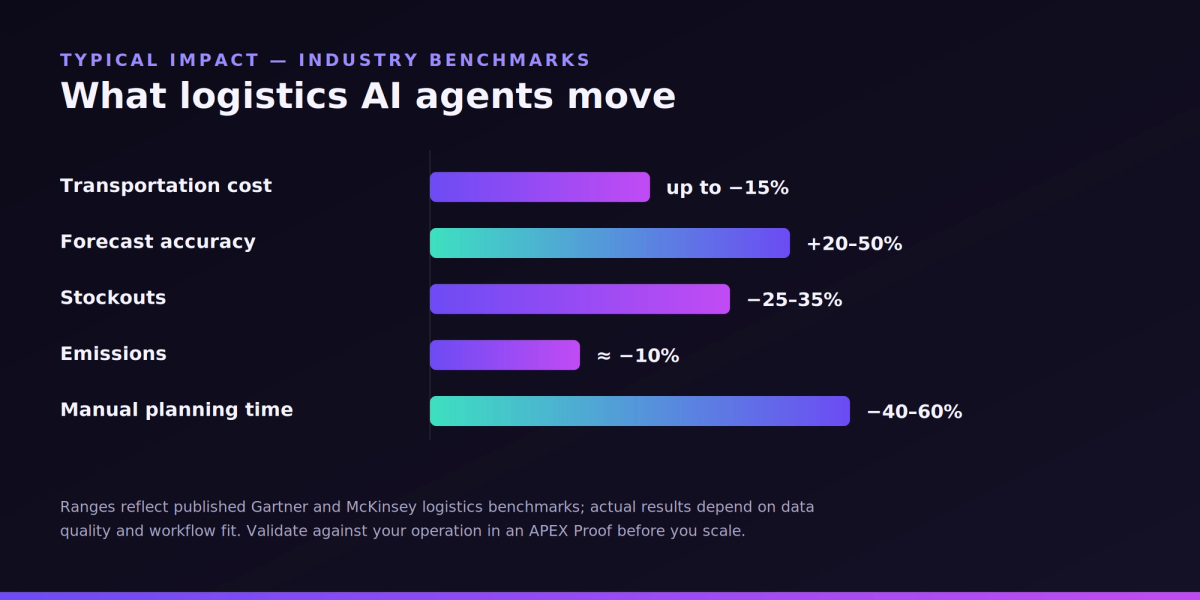
| Lever | Typical impact (benchmark) |
|---|---|
| Transportation cost | up to −15% |
| Forecast accuracy | +20–50% |
| Stockouts | −25–35% |
| Emissions | ≈ −10% |
| Manual planning time | −40–60% |
The compounding effect is where the real return lives: forecasting, routing, procurement, and document processing agents each save something, but coordinated across the operation they turn a fragmented, reactive supply chain into a self-optimizing one.
A word of caution that separates the projects that hit these numbers from the ones that don't: efficiency gains track directly with data quality and workflow fit. A route optimizer disconnected from your order management system is working with incomplete information and will underperform its benchmark. This is exactly why we validate against your actual data — your routes, your stop volumes, your edge cases — in a short proof before anyone talks about scaling. More on that below.
Why logistics AI agent projects stall — and how to avoid it
If 40%+ of agentic projects get canceled, the failure patterns are worth naming, because every one of them is preventable. They're rarely about the model. They're about delivery.
The impressive demo that never ships. Teams prove the easy part (an LLM can summarize a manifest) and skip the hard question: can the agent reliably reconcile 40 carrier formats and handle exceptions inside your SLA? The fix: make your first step a focused proof that targets the single riskiest assumption on your real data. If the hard part doesn't work, you learn it in days, not months.
Underestimating the data work. Logistics data is scattered across TMS, WMS, and ERP systems with mismatched formats. Teams budget for models and treat data prep as a footnote — yet Gartner warns organizations will abandon 60% of AI projects unsupported by AI-ready data. The fix: treat data readiness as a dedicated workstream with its own timeline, not an afterthought squeezed into sprint zero.
No evaluation framework. An agent that hallucinates a delivery ETA or misreads a customs field is invisible until it isn't. The fix: build automated evaluation before you build production — accuracy benchmarks on real data, hallucination tests, and thresholds that alert you before users notice degradation.
Agents that degrade after launch. Models drift, carrier APIs change, new exceptions emerge; a one-time build quietly gets worse. The fix: plan for continuous monitoring and periodic retraining from day one, and budget for it as a permanent line item rather than a project cost.
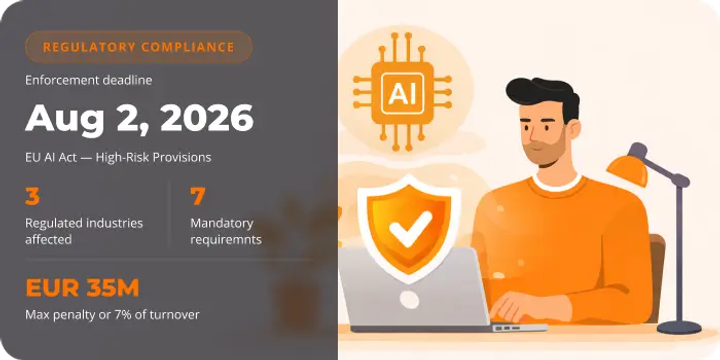
Compliance discovered too late. For cross-border and regulated freight, retrofitting governance is an estimated 3–5× more expensive than building it in. The fix: design data governance, auditability, and standards such as SOC 2, ISO 27001, GDPR, HIPAA, or PCI DSS into the architecture from the start. (For the regulatory landscape, see our EU AI Act compliance guide.)
The common thread is discipline: validate before you commit, and gate the work so problems surface early. It's the model we use with our APEX platform, but the principles apply whoever builds your system. We go deeper on these patterns in why most AI agent projects fail.
Single-agent or multi-agent? Match the architecture to the problem
One of the most expensive early mistakes is choosing the wrong architecture — usually by over-building.
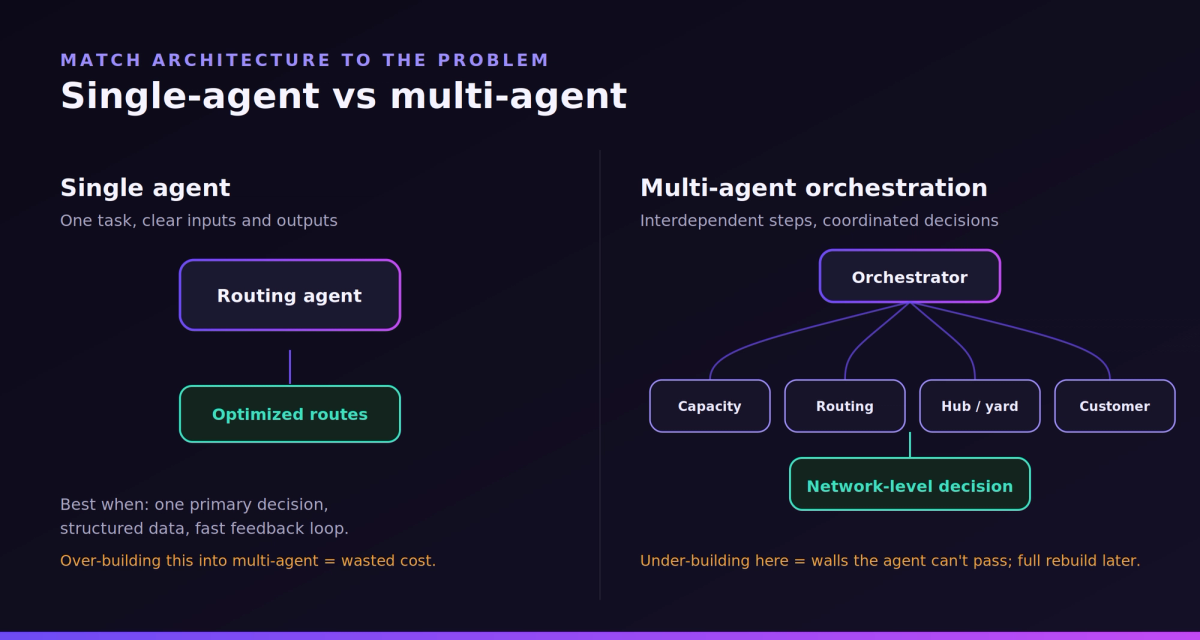
A single agent handles one task with clear inputs and outputs — a routing agent that produces optimized routes, for example. Choose it when the workflow has one primary decision, structured data, and a fast feedback loop.
A multi-agent system coordinates specialized agents — capacity, routing, hub/yard, customer — under an orchestrator that produces network-level decisions no single rule-based engine could reach. Choose it when steps are genuinely interdependent.
The decision framework isn't complicated: one primary task → start single-agent; multiple interdependent steps needing different reasoning → multi-agent earns its complexity. Most failures in this category come from teams building elaborate multi-agent systems for problems a well-designed single agent would solve, at 3–5× the appropriate cost. When you do need coordination, using pre-built orchestration patterns, memory management, and agent communication means you configure that infrastructure rather than building it from scratch — the approach we take with APEX.
A staged path from pilot to production
Whatever tools you use, the projects that reach production tend to follow the same shape: prove, build, operate, scale — with an explicit decision gate between each stage so risk is retired before budget is committed.
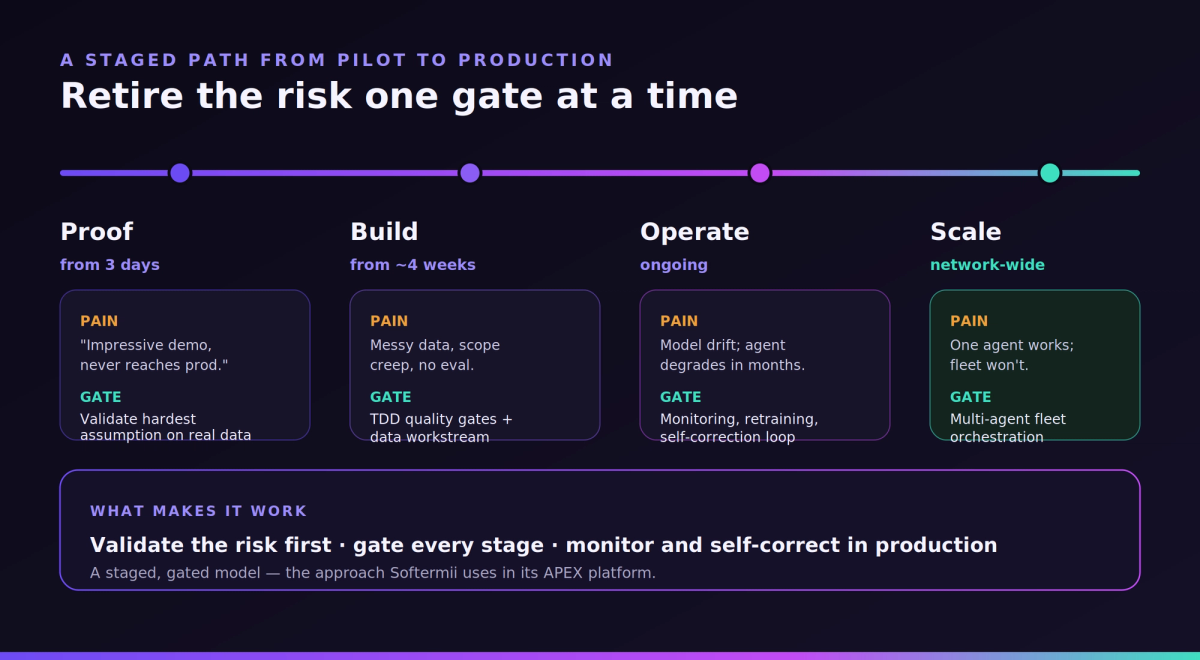
- Proof / pilot — validate the hardest assumption on your real logistics data; produce a working prototype and a clear go/no-go before committing to a full build.
- Build — ship a production-ready agent with data preparation, integrations, QA, and monitoring built in, not bolted on.
- Operate — keep it reliable with continuous monitoring, retraining, and prioritized iteration as conditions change.
- Scale — expand from one agent to an orchestrated fleet across dispatch, capacity, and customer workflows once the core is solid.
This staged, gated model is how we structure delivery with our APEX platform (Proof → Build → Evolve → Scale), but the sequence matters more than the vendor — skipping the proof and going straight to a full build is the single most common way logistics projects end up in the cancellation column.
Build vs. buy: where a platform changes the math
Off-the-shelf logistics AI tools get you started fast but bend your operation to their assumptions and rarely handle your edge cases. Building from scratch fits your operation exactly but is where budgets and timelines blow up — and where MIT's 2025 data is sobering: internal AI builds succeed only about 22% of the time versus 67% when working with specialized vendors.
The productive middle is a platform-accelerated custom build: your workflows and data, but on top of pre-built orchestration, quality gates, and monitoring so you're not re-solving infrastructure on every project. It's why staged delivery matters more than raw model choice. For a full cost breakdown, see our AI agent development cost guide.
What to look for in a logistics AI partner
1. Domain experience in logistics specifically — dispatch and carrier data behave nothing like other verticals. Ask for relevant case studies.
2. A staged approach with real exit points — a genuine POC and a go/no-go decision before any six-month commitment.
3. An evaluation methodology they can explain — how they test for hallucinations and measure accuracy on your data.
4. Post-launch operations capability — who keeps the agent reliable when a carrier API changes at 2 a.m.
5. Transparent pricing with guarantees — scope creep kills logistics projects quietly; look for contractual commitments.
For context on our own work, we've built AI systems across 100+ projects since 2014 with a 4.9 Clutch rating — see our AI agent development services. But whoever you choose, ask these questions and verify the answers.
A real example
Our AI Agent for Supply Chain Optimization case study shows these ideas in production: an agent-driven system built on a stack including NetworkX, Pyomo, Prophet, and PyTorch for optimization and forecasting. It's a concrete look at how dispatch, routing, and forecasting come together beyond a demo. Browse more in our case studies.
Frequently Asked Questions
What is an AI agent in logistics?
An AI agent in logistics is autonomous software that observes live operational data, decides on an action, and executes it toward a goal — such as rerouting a delayed shipment or rebooking a carrier — with humans setting objectives and handling exceptions rather than approving every step. Unlike a traditional TMS that reports a problem, an agent acts on it.
Do AI agents replace a TMS or WMS?
No. AI agents work on top of your TMS, WMS, and ERP, not instead of them. Those systems remain the system of record; the agent adds a decision-and-action layer, which is why integration with your existing data sources is the single biggest driver of results.
What are the highest-ROI logistics use cases for AI agents?
Dispatch optimization, dynamic route optimization, demand forecasting, carrier intelligence, exception handling, and returns/reverse logistics. Published benchmarks associate AI route optimization with up to ~15% lower transportation costs and ~10% lower emissions, and forecasting with 20–50% accuracy gains, though actual results depend on data quality.
How long does it take to deploy a logistics AI agent?
A focused proof of concept validating the riskiest assumption can be built in days with a framework like APEX. A production-ready single agent typically takes a few weeks; an orchestrated multi-agent system with full integration and testing takes longer. Timelines hinge heavily on data readiness.
How much does a logistics AI agent cost?
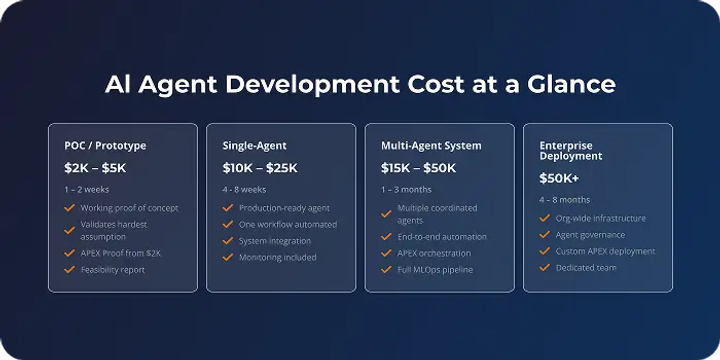
Cost scales with scope — from a low-cost proof of concept to a production build to an enterprise multi-agent fleet. The bigger financial risk is a failed project: total impact often runs 2–4× the direct build cost once opportunity cost is included. Validating with a staged proof first is the cheapest insurance. See our AI agent development cost guide for detail.
Should I build a single agent or a multi-agent system?
Start with a single agent when the workflow has one primary task, structured data, and a fast feedback loop. Move to multi-agent orchestration only when steps are genuinely interdependent. Over-engineering into multi-agent when a single agent would do is the more common and more expensive mistake.
Why do logistics AI projects fail?
Most fail on delivery, not technology: proving the easy part instead of the risky one, underestimating data preparation, shipping without an evaluation framework, and treating the agent as a one-time build. Gartner expects over 40% of agentic AI projects to be canceled by the end of 2027.
Do AI agents need ongoing maintenance?
Yes. Models drift, carrier and mapping APIs change, and new exceptions appear, so agents need continuous monitoring, periodic retraining, and optimization. Budget for ongoing operations from the start rather than treating the agent as a one-time build — it's the difference between a system that improves and one that quietly degrades within months.
Where to go from here
The failure rate in agentic AI isn't inevitable — it's the predictable result of skipping validation. If you're scoping a logistics AI agent, the lowest-risk next step is to test the hardest part against your real data before committing serious budget.
If you'd like a hand with that, tell us what you're moving and we'll give you an honest read on whether an AI agent is the right tool — and, if it is, a focused proof against your own use case through our APEX delivery model.
How about to rate this article?
3 ratings • Avg 5 / 5 · Thanks for rating!
Written by:

Co-Founder
Andrii Horiachko is a Co-Founder of Softermii with over 12 years of experience in software development, eight of them spent building and managing Softermii itself. He is responsible for technology-innovation in clients’ projects, making sure every product runs on a modern, carefully chosen tech stack that can sustai…