
AI Forward Deployed Engineering: How to Turn AI From a Cost Center Into Measurable Outcomes

Want to know more? — Subscribe
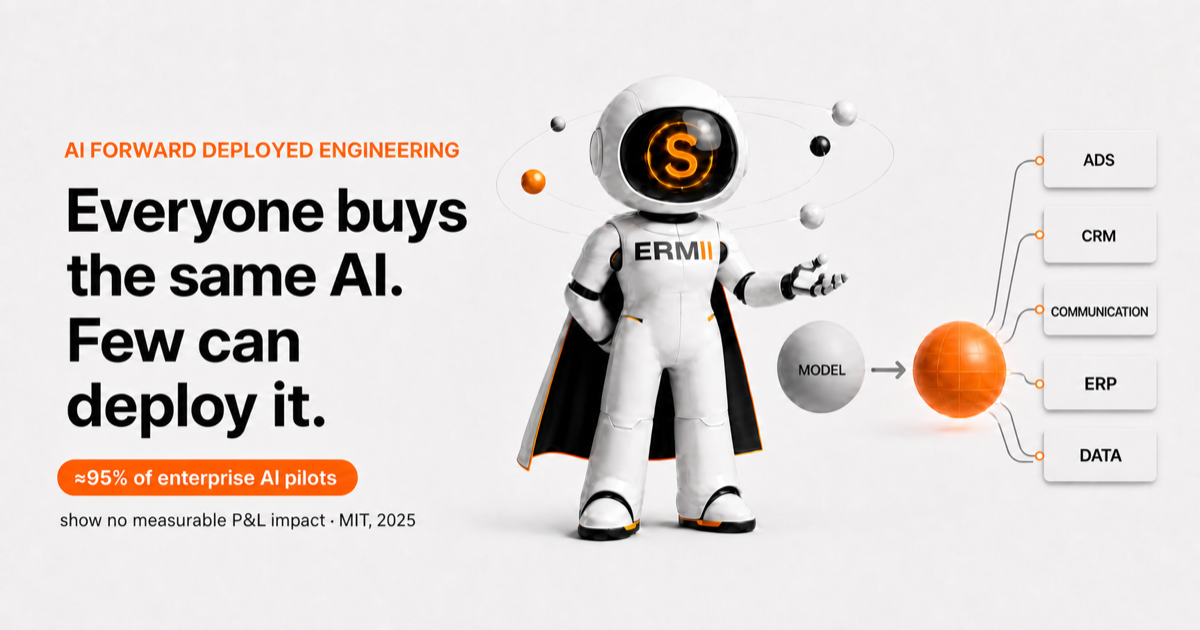
About 95% of enterprise AI pilots never reach measurable impact, not because the model is weak, but because deployment fails. That last mile is the whole game.
Want a skimmable version?
Get a quick overview of this article with AI to reach the key points fast.
Generate AI SummaryHide summary
Want a skimmable version?
Get a quick overview of this article with AI to reach the key points fast.
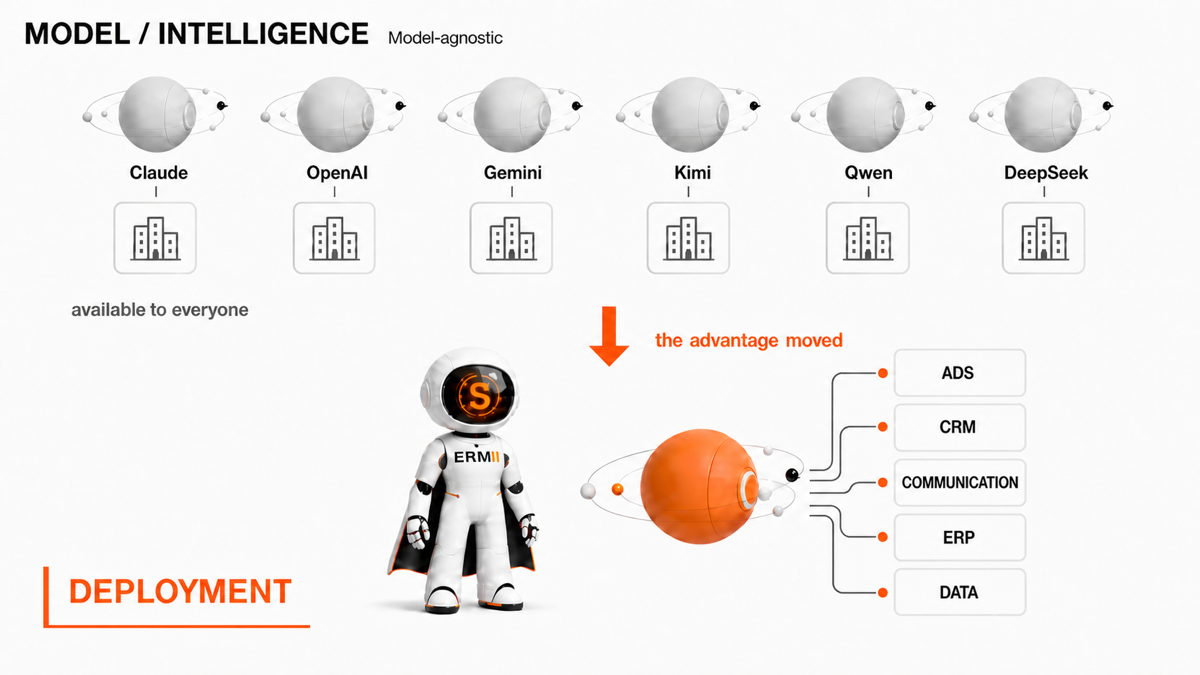
Generate AI SummaryHide summaryEvery company can now buy the same AI, so the advantage has moved from the model to deployment. The key points:
Why the Old Software Model Is Breaking
For a decade, enterprise software followed one playbook. Buy licenses, onboard users, expand seats, renew. Value tracked access. More logins meant more revenue.
That logic is failing. One AI agent can now do the work of several people. So your operations improve while your seat count shrinks. The Technology & Services Industry Association calls this shift AI Economics: a move from selling access to selling outcomes.
But outcomes are not automatic. Around 95% of enterprise generative-AI pilots deliver no measurable impact on the P&L, according to MIT's 2025 State of AI in Business report.
Most AI agent projects also stall before production, Forrester finds.
The models work in the demo. They just don't survive contact with a real, messy environment.
That last mile is the whole game. The discipline that wins it has a name: AI forward deployed engineering.
What Is Forward Deployed Engineering?
Forward deployed engineering is a delivery model. Engineers embed directly inside a customer's environment to build, customize, and deploy AI that produces measurable outcomes.
A forward deployed engineer (FDE) is a hybrid. Part software engineer, part embedded consultant. Instead of building generic features for thousands of customers, an FDE solves one specific problem for one organization.
The role was popularized by Palantir. Its engineers deployed on-site, learned client workflows in detail, and built tailored tools on top of a flexible platform. It worked because the software was bent to the customer's reality, not the other way around.
In 2026 the model went mainstream. OpenAI launched "The Deployment Company" to embed engineers inside large enterprises. Google, Databricks, Salesforce, and others now hire for the title, with senior roles posted at $185,000 to $300,000+.
The logic is simple. Everyone can buy intelligence, so intelligence is no longer the moat. The edge moves to where, how, and why you apply it.
Why Most Enterprise AI Fails
The failure is rarely the model. It is almost always one of three deployment gaps.
- The work is not what the org thinks it is. Ask someone to describe a workflow and you get the clean version: an email arrives, we process it. The reality is 40 senders, 40 formats, and half of them exceptions that live in one person's head.
- Intelligence lands where it does not belong. In a ten-step workflow, maybe three steps need real judgment. The rest are better handled by deterministic code and API calls.
- Nobody owns the outcome. Traditional SLAs measure uptime. AI value is measured in accuracy, cycle time, and revenue lift. Without an owner for business results, the project drifts into a science experiment.
Forward deployed engineering closes all three gaps at once. That is why it needs both a strong engineer and a strong consultant, in the same operating model.
The Two Kinds of Judgment That Make It Work
Two very different skills have to live in one engagement.
- Business fluency. Reading workflows, incentives, risk, and adoption. Translating an ambiguous problem into a solvable one. Earning trust inside the account.
- Technical depth. Production-grade code, data pipelines, model selection, evaluation suites, guardrails, and reliable deployment.
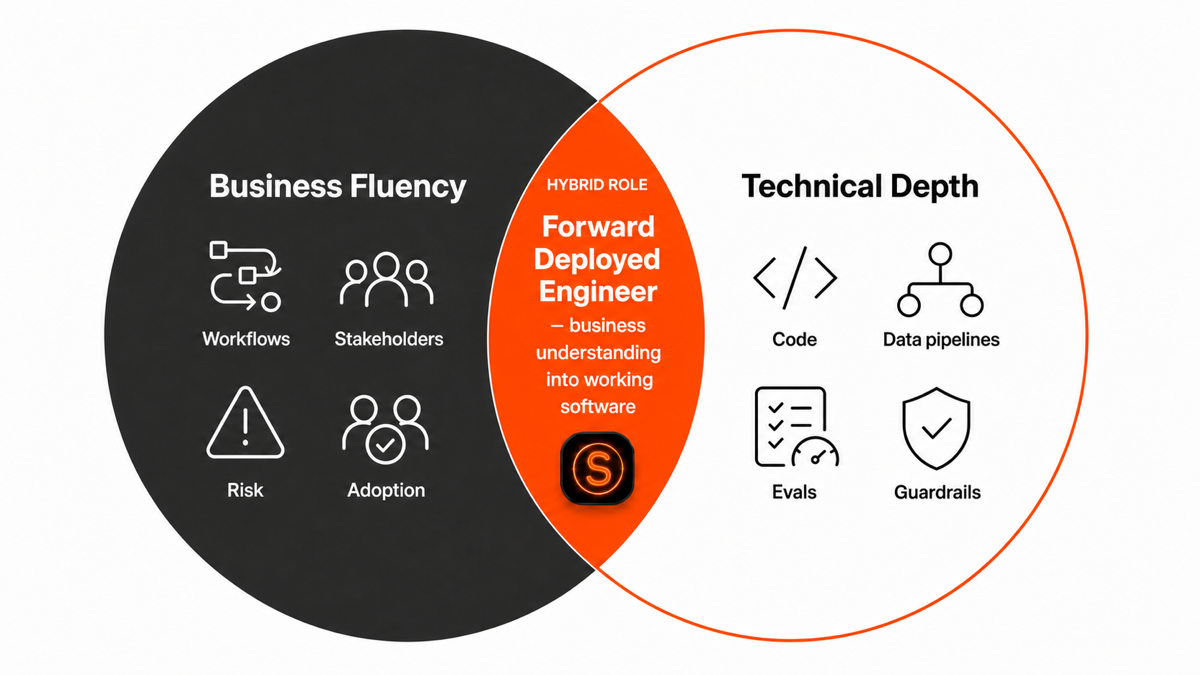
Most people are strong on one side and passable on the other. The value comes from combining both at a high level, so business understanding becomes working software end to end.
For a buyer, the takeaway is direct. Whoever you trust with AI deployment must be excellent at both. A brilliant model with a weak grasp of your operations lands you in the 95%.
The Deployment Playbook: Audit, Evaluate, Deploy
Good forward deployed engineering follows a disciplined loop. Softermii runs this on every AI agent engagement.
- Audit. Map how the work really happens: every step, every exception, every hand-off. The output is an operating map plus an ROI matrix of what is worth automating and what is not.
- Evaluate. Build evaluation suites against golden datasets. Run the system 50 times, measure the pass rate, and categorize every failure. Route anything unsafe to a human. It seems to work becomes it works 94% of the time, and here is the other 6%.
- Deploy. Integrate with the CRM, ERP, and data sources already in place. Move from shadow mode to increasing autonomy to production. De-risk the change instead of forcing a migration.
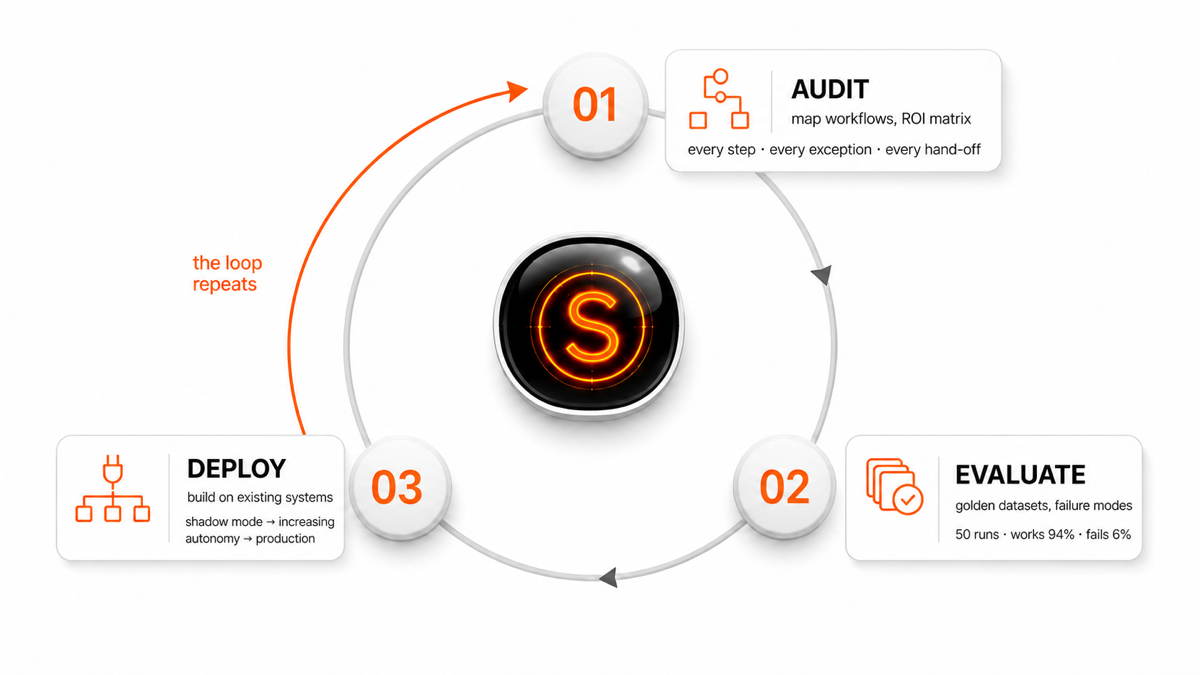
Then the loop repeats. Fix one workflow and the next bottleneck becomes obvious. That is why AI, done well, spreads across an organization instead of sitting in one pilot.
This mirrors TSIA's DARE framework for the AI era: Design, Activate, Realize, Evolve. Renewal stops being a sales event and becomes a result of proven performance.
Not All AI Is the Same: Three Tiers of Automation
The gap between AI that assists and AI that transforms comes down to architecture. It helps to know which tier you are buying. Not every process needs Tier 3; a standard, low-variance workflow is often better served by simple automation or off-the-shelf software.
| Tier | What it is | Reality in production |
|---|---|---|
| Tier 1 — Basic automation | Rule-based workflows with simple logic | Rigid, breaks on edge cases, high manual overhead |
| Tier 2 — Assisted intelligence | ML models recommend, humans approve each step | Helpful but passive, scaling limited by reviewers |
| Tier 3 — Agentic (Softermii APEX) | Autonomous agents that reason, adapt, and orchestrate | True leverage, agents handle exceptions and coordinate systems |
Forward deployed engineering is what gets you safely to Tier 3. Softermii APEX is built for it.
What This Looks Like in Practice
Softermii applies this outcome-first model through Softermii APEX, its agentic-AI delivery solution. It is not a chatbot wrapper or a thin layer over a framework. It runs on three pillars.
- Multi-agent orchestration. Specialized agents coordinate through structured workflows. The platform stays model-agnostic across Claude, OpenAI, and Gemini, picking the right model per task.
- Quality-gate architecture. Every stage passes anti-pattern detection and test-driven approval gates before anything reaches your codebase.
- Closed-loop self-correction. When agents detect issues, they re-analyze and retry until tests pass. Human experts step in only at strategic checkpoints.
The point is not the platform for its own sake. It lets an engagement skip much of the undifferentiated infrastructure work and spend the time where value lives: your domain logic and your edge cases. It is also privacy-first, with zero code retention, full IP ownership, and SOC 2, ISO 27001, GDPR, HIPAA, and PCI DSS support.
Two results from Softermii's case studies:
- Insurance claims. A multi-agent system for intake, damage assessment, and adjuster assignment cut claim cycle time from 11 days to 3, tripled volume capacity, and reached ROI payback in 4 months.
- Fintech KYC. A single-agent onboarding system took processing from 72 hours to 15 minutes, cut abandonment by 28%, and auto-approved 88% of applicants.
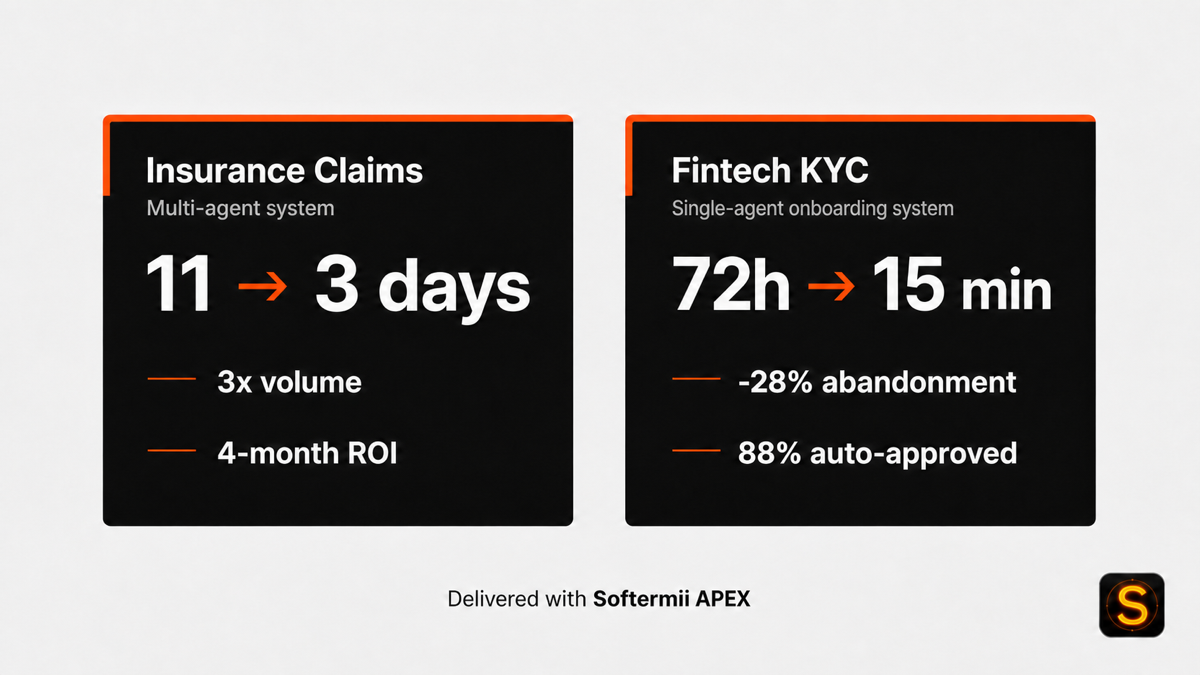
In both cases the win came from deploying intelligence into existing systems against measured KPIs. Not from a smarter model than anyone else could buy.
See it on your own workflow
Softermii APEX turns one process into a working proof of concept from $1,000 in 3 days.
Explore Softermii APEXHow to Evaluate an AI Deployment Partner
Use this as a shortlist filter. A partner worth their fee should:
- Start with an audit, not a build. If they want to write code before mapping your workflows, walk away.
- Show the work. Agent traces, logs, and audit trails should be visible. If you cannot see what the agent did, you cannot trust it.
- Bring evals, not vibes. Ask how they measure accuracy, hallucination rate, and failure modes against your data.
- Build on your stack. Integration with your CRM and ERP beats a forced migration every time.
- Commit to outcomes. Revenue lift, risk reduction, and cost savings are the three buckets that matter. Name them up front.
- Prove before you scale. A working proof of concept should validate the hardest assumption before a full commitment.
The Bottom Line
Intelligence is now a commodity you can buy off the shelf. The durable advantage belongs to the organizations that deploy it best. Into real workflows, against real KPIs, with someone accountable for the result.
That is what AI forward deployed engineering delivers. It is also why the market is quietly repricing everything around outcomes instead of access.
The companies that win the next few years will not be the ones with the most tokens. They will be the ones who closed the last mile.
Want to close your AI value gap? Tell Softermii the process you want to automate. You will get a feasibility assessment, a recommended architecture, and a fixed-scope proposal within 5 business days. Get a free proposal.
Frequently Asked Questions
What is AI forward deployed engineering?
It is a delivery model where engineers embed in a customer's environment to implement and optimize AI so it produces measurable outcomes rather than stalling as a pilot. It blends production engineering with hands-on business understanding.
Why do most enterprise AI projects fail?
Not because of the model. They fail on deployment. The real workflow is more complex than documented, intelligence gets applied where it does not belong, and no one owns the business outcome. MIT puts the pilot failure rate near 95%.
How is an FDE different from a consultant or a software engineer?
A consultant understands the business but usually cannot ship production software. An engineer ships but may miss the operational context. An FDE does both, turning business understanding into working, monitored software.
What is the fastest way to start without over-committing?
Begin with an audit to map workflows and quantify ROI. Then run a low-cost proof of concept that validates the hardest assumption before a full build. The Softermii APEX proof of concept starts from $1,000 in 3 days.
How do you measure AI success?
Three buckets: revenue uplift, risk mitigation, and cost savings. Track them with evaluation suites and production monitoring against your own benchmarks for accuracy, cycle time, and latency.
- #AI forward deployed engineering
- #forward deployed engineer
- #outcome-based AI
- #enterprise AI deployment
- #AI agent ROI
- #agentic AI
- #Softermii APEX
How about to rate this article?
2 ratings • Avg 5 / 5 · Thanks for rating!
Written by:

Head of Sales Department
A seasoned business development leader with over 10 years of experience driving growth across the global IT landscape — spanning both SaaS products and software service companies. With a proven track record of scaling businesses internationally by 5X, he brings a rare combination of strategic vision, market intuitio…