
Best AI Agent Development Agencies for Startups (2026)

Want to know more? — Subscribe
Choosing an AI agent development agency for a startup? Score agencies on the same seven criteria, map the three agency types, and match one to your own build.
Key takeaways
- “Best” depends on your build — enterprise consultancies, nearshore staff-augmentation firms and AI-native delivery shops each win a different job.
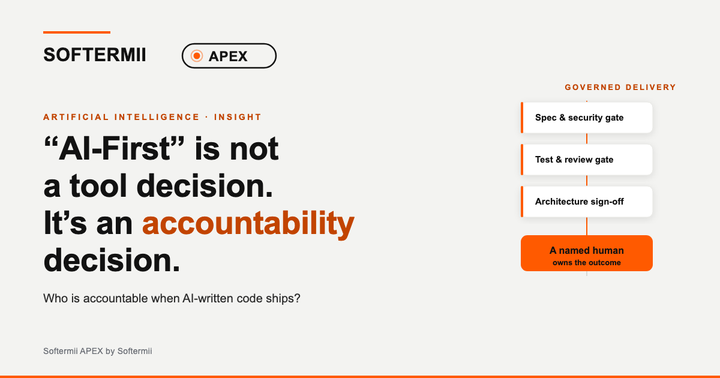
- AI speed is real but so is the tax: GitClear 2026 found duplicated code up 81% since 2023; DORA 2025 links higher AI adoption to both faster delivery and more instability.
- Score every agency on seven things: real mechanism, inspectable governance, contracted maintainability, code ownership, price certainty, speed to working software, named accountability.
- Softermii APEX is built for the case in between hiring and DIY — a fixed price agreed before work starts, you own every line, and maintainability is contracted.
Every software team you might hire now leads with the same two letters: AI. Agents, copilots, automated delivery. For an idea leader with a product to ship — a founder, a CMO, an operations lead, a product owner — that is genuinely good news: a small team can now build what used to need a big one.
It has also made the shortlist harder, not easier. The roundup posts all rank the same enterprise names, and every vendor promises the same speed. So the useful question is not “who is number one?” — it is “which agency is right for the thing I am actually building, and how do I tell real delivery from a good demo?” This guide gives you the framework, the market landscape, and where each type fits.
What makes an AI agent development agency worth hiring in 2026?
The best AI agent development agency for a startup is the one that ships software you can own and maintain at a price you agreed up front — not just the one that ships fastest. Speed is now table stakes; the differentiator is whether the codebase is still cheap to run six months after handover.
The data is why this matters. AI-assisted delivery is fast, but it carries a measurable quality tax:
| Signal | What the research found | What it means when you are buying, not coding |
|---|---|---|
| Google DORA 2025 | More than 80% of developers say AI raises their productivity — yet about 30% still distrust AI-generated code, and higher AI adoption correlates with both faster delivery and more instability | The speed is real, and so is the instability, unless someone is accountable for governing it |
| GitClear 2026 (623M changed lines) | Duplicated code blocks are up 81% since 2023, and refactoring fell to 3.8% of changed lines | More copy-paste, less cleanup: cheap to launch, expensive to change later — a cost that lands after the invoice clears |
That is the trap a startup has to steer around: buying velocity now and inheriting a maintenance bill later. The agency worth hiring is the one that closes that gap contractually, not the one that ignores it.
The 7 criteria to evaluate any AI agency
Score every agency on the same seven criteria and the differences get obvious fast. Vague “AI-native” language collapses under specific questions; real delivery gets more concrete when you probe it.
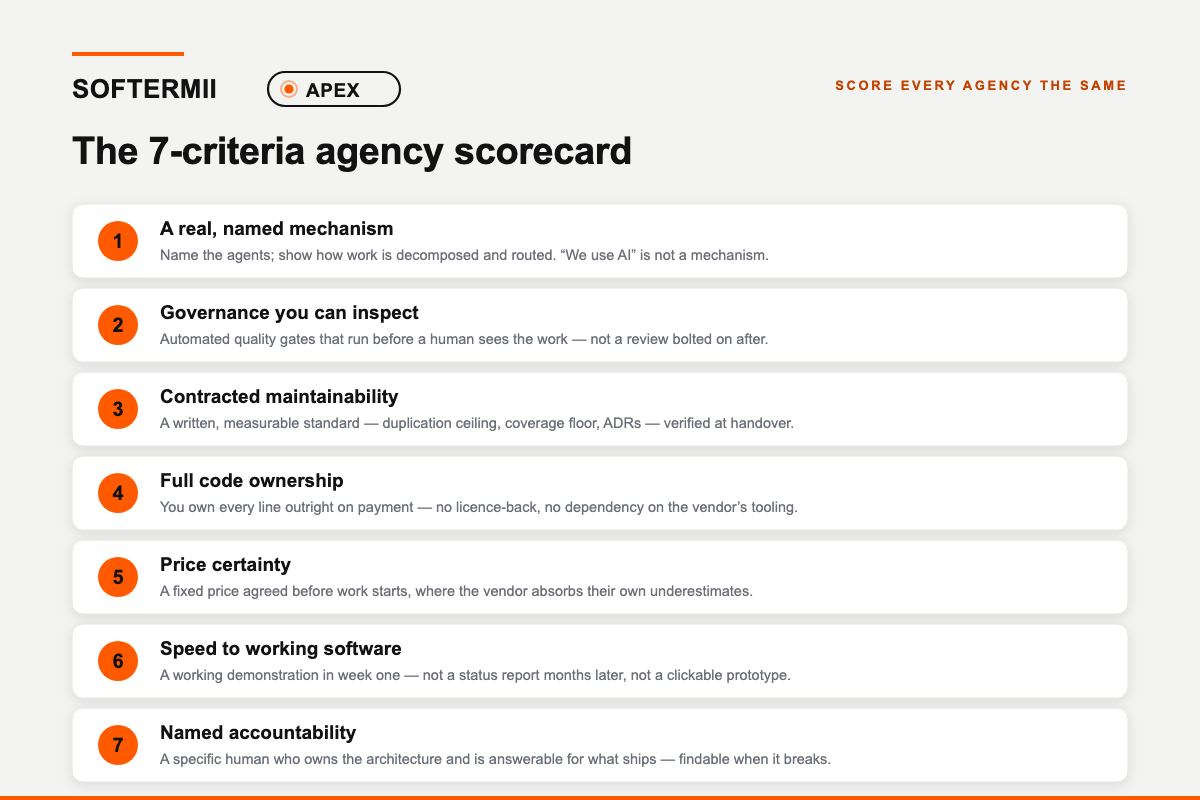
| # | Criterion | The evidence to demand |
|---|---|---|
| 1 | A real, named mechanism | Name the agents; show how work is decomposed and routed. “We use AI” is not a mechanism. |
| 2 | Governance you can inspect | Automated quality gates (spec, static analysis, security, duplication/complexity) that run before a human sees the work — not a review bolted on after. |
| 3 | Contracted maintainability | A written, measurable standard (duplication ceiling, coverage floor, complexity ceiling, ADRs, takeover-readiness) — verified at handover, not promised on a call. |
| 4 | Full code ownership | You own every line outright on payment — no licence-back, no dependency on the vendor’s tooling to run or change it. |
| 5 | Price certainty | A fixed price agreed before work starts, where the vendor absorbs their own underestimates — not an estimate that revises upward. |
| 6 | Speed to working software | A working demonstration in week one, not a status report months later — and not a clickable prototype. |
| 7 | Named accountability | A specific human who owns the architecture and is answerable for what ships — findable when something breaks. |
The pattern to watch for: the further an agency gets from criterion 1, the more it leans on adjectives. A real operation answers criteria 1–3 with artefacts you can see; agent-washing answers them with a brand deck.
The AI development agency landscape: three types
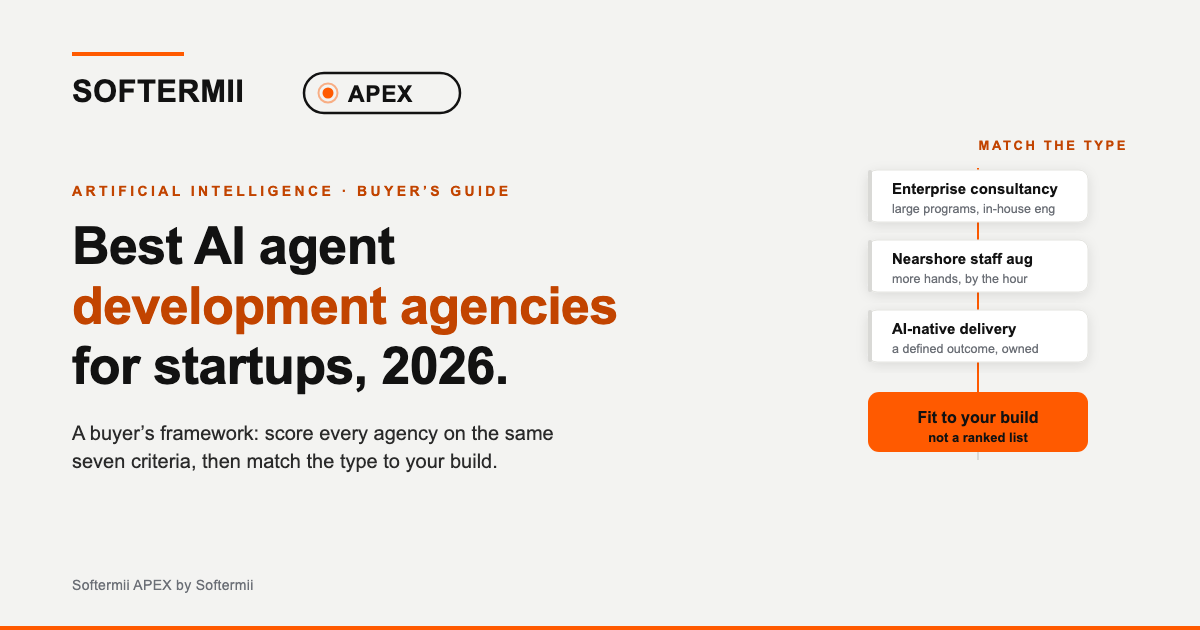
AI development agencies fall into three broad types, and each is genuinely best at a different job. “Best” is a matter of fit — an enterprise consultancy and a boutique AI-native shop are not competing for the same build. Here is the honest map.
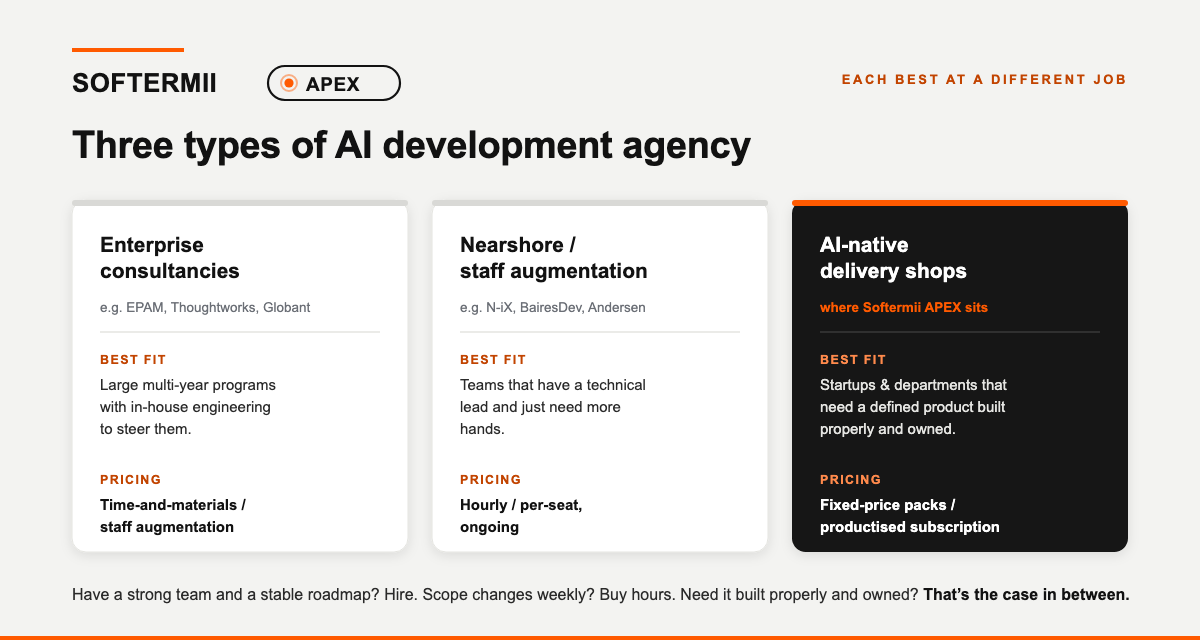
| Type | Model | Best fit | Typical pricing |
|---|---|---|---|
| Enterprise consultancies (e.g. EPAM, Thoughtworks, Globant) | Large global engineering orgs, often embedded alongside your own teams | Multi-year, large-scale programs with existing in-house engineering to steer them | Time-and-materials / staff augmentation |
| Nearshore / staff augmentation (e.g. N-iX, BairesDev, Andersen) | Rent additional engineering capacity by the hour or by the seat | Teams that have a technical lead and just need more hands | Hourly / per-seat, ongoing |
| AI-native delivery shops (where Softermii APEX sits) | Small expert cores directing an agent fleet to deliver a defined outcome | Startups and departments that need a specific product built properly and owned — without hiring a team | Fixed-price packs / productised subscription |
None of these is “wrong.” If you have a strong in-house team and a stable roadmap, hire. If your scope changes weekly by design, buy hours. If you want to validate a rough idea this weekend, a DIY builder tool is genuinely fine. The AI-native model exists for the case in between: you know the outcome you need, you want it built properly and owned by you, and you want the price fixed before you commit.
One caveat for AI-native and DIY options specifically: the EU AI Act, Article 50 (transparency obligations in force 2 August 2026) means whoever builds an AI-containing product has real disclosure and role-allocation duties. Ask any agency how they handle it; the good ones already have.
Where Softermii APEX fits
Softermii APEX is a proprietary agentic AI engineering engine that turns your idea into working, production-ready software for one fixed price agreed before a single line of code is written. It is built for the AI-native job above — a defined outcome, owned by you, priced before you commit — and it answers all seven criteria with commitments rather than adjectives. See Softermii APEX and its AI agent development services.
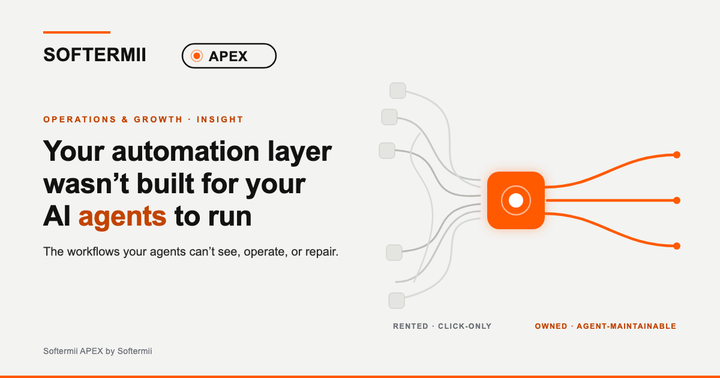
- A real mechanism, not agent-washing — three named pillars (Multi-Agent Orchestration, Quality Gate Architecture, Closed-Loop Self-Correction) with a deterministic control layer, plus a named agent fleet that is demonstrable on request.
- Governance as the delivery mechanism — no feature advances on an agent’s own say-so; fixed automated gates run first, and anything that carries real risk escalates to a named Softermii expert.
- Contracted maintainability — a measurable standard verified at handover. One client’s codebase was documented well enough for their internal team to take over development without a rebuild.
- You own every line — outright, on payment. No licence-back, no dependency on the engine.
Price certainty — one fixed price; Softermii absorbs its own underestimates (see pricing). Working software in week one, a 15 / 30 / 60-day warranty, and rework that never consumes your delivery time.
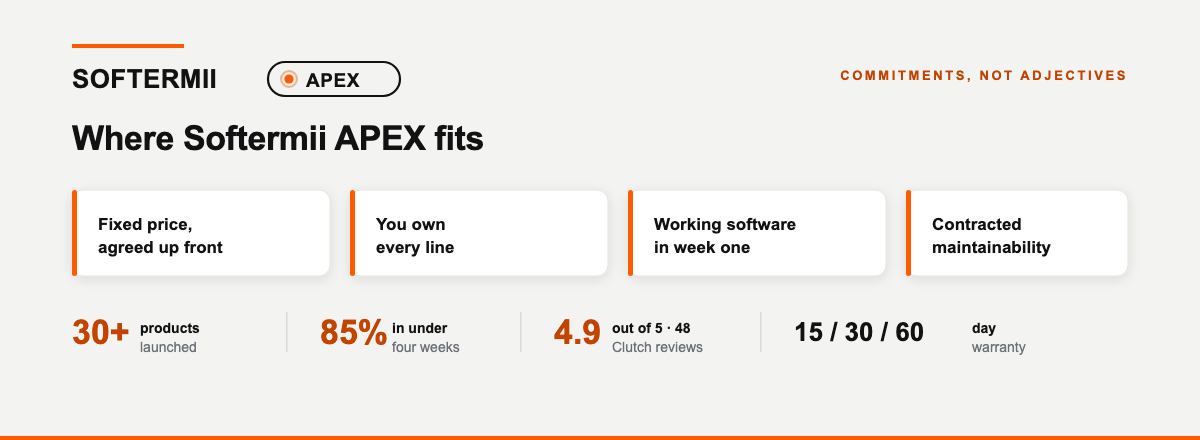
The proof is public and named. IOMI, an AI wealth-management platform, is a brownfield takeover — Softermii APEX took over another firm’s concept and built the production product on top. Thrive Portal shipped 101 features across web, iOS and Android in six weeks. RadShifts is a live healthcare-staffing marketplace. Across the portfolio, 30+ products have launched with Softermii APEX, 85% of them in under four weeks — rated 4.9 / 5.0 across 48 verified Clutch reviews, with a Top Clutch AI Agents Company, 2026 badge.
Softermii APEX will not be the right pick for everyone — and the honest framing above says exactly when it is not. But if you are an idea leader who has been burned by an estimate that grew or a codebase you could not maintain, it is built for precisely that fear.
The governing rule we hold ourselves to
Humans own architecture, validation and accountability. Agents produce and verify volume. Governance isn’t a brake on delivery — it is the delivery mechanism.
Choosing an AI development partner?
Get your free itemised estimate — a named, Feature-level breakdown at one fixed price, with a working demonstration in week one. You see the budget. We absorb the unknowns.
Get your free itemised estimateFrequently asked questions
What is the best AI agent development agency for a startup?
There is no single “best” — it depends on your build. Enterprise consultancies suit large programs with in-house engineering; nearshore firms suit teams that just need more hands; AI-native shops like Softermii APEX suit startups that need a defined product built properly, owned outright, and priced before they commit. Score every candidate on the same seven criteria.
How do I know an agency’s “AI agents” are real and not marketing?
Ask them to name the agents, show how work is decomposed and routed, and show the automated quality gates that run before a human reviews the output. Real delivery gets more concrete under questioning; agent-washing gets vaguer.
Is AI-generated code maintainable?
It can be, but only if maintainability is engineered and contracted. Industry data (GitClear 2026, DORA 2025) shows AI raises both speed and instability, so demand a written, measurable maintainability standard — duplication ceiling, coverage floor, ADRs, takeover-readiness — verified at handover.
Will I own the code an AI development agency builds?
You should own every line outright on payment, with no licence-back and no dependency on the vendor’s tooling. With Softermii APEX, method of creation (engineer or engine) is irrelevant to ownership — it is yours to run and change.
How much does it cost to build production-ready software with AI agents?
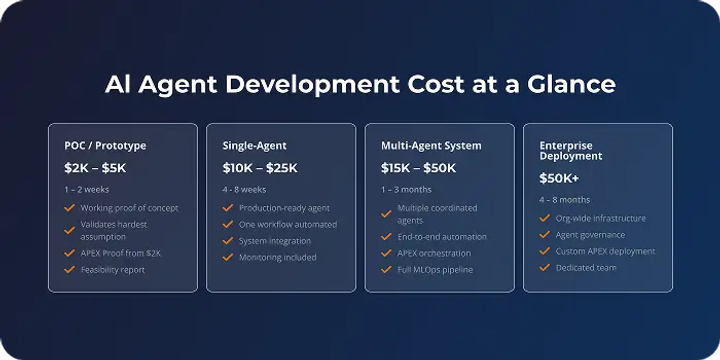
It varies by scope, but the model matters more than the number: a fixed price agreed before work starts protects you from the estimate creep of time-and-materials. Softermii APEX prices fixed-price packs before you commit.
- #AI agent development agency
- #AI development agency for startups
- #production-ready software
- #fixed-price MVP
- #AI code ownership
How about to rate this article?
0 ratings • Avg 0 / 5 · Thanks for rating!
Written by:

Co-Founder
Andrii Horiachko is a Co-Founder of Softermii with over 12 years of experience in software development, eight of them spent building and managing Softermii itself. He is responsible for technology-innovation in clients’ projects, making sure every product runs on a modern, carefully chosen tech stack that can sustai…